
Cast Iron Vs Steel: Differences Between These Metals and Pros and Cons
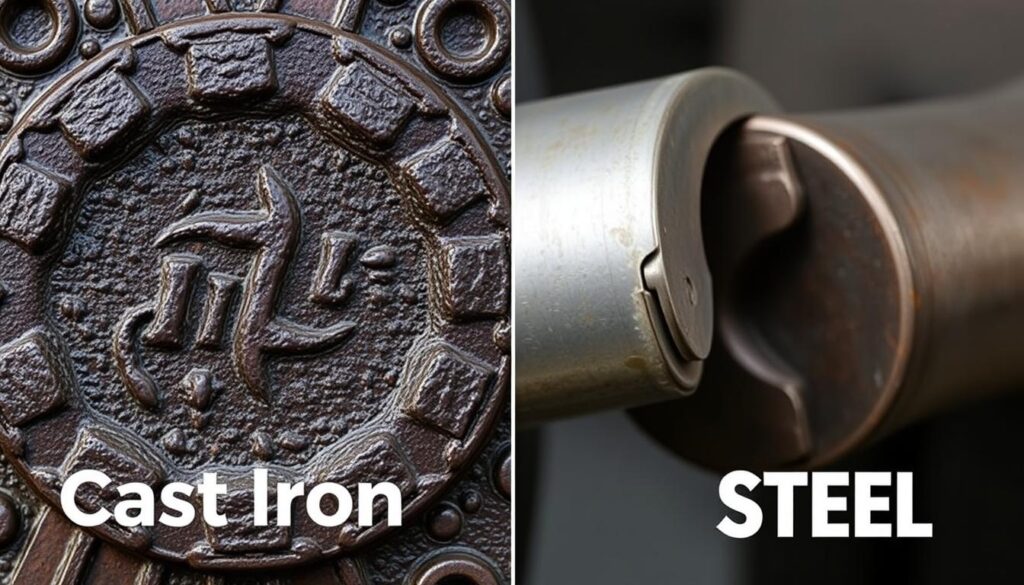
What sets cast iron apart from steel? At first glance, they might look the same. But they have special qualities that make them useful for different things.
Cast iron is iron and carbon that has more than 2% carbon in it. Steel has iron and carbon, but it doesn’t have more than 2.11% carbon. This difference in how they are made changes how strong they are, how long they last, and how they are used.
It’s important to know what makes cast iron and steel different. It helps you choose the best materials for your project, whether it’s building, cooking, or making things.
Key Takeaways
- Cast iron has more than 2% carbon, while steel has between 0.02% and 2.11% carbon.
- The carbon content greatly impacts their properties and uses.
- Because cast iron is strong, it’s great for making cookware and parts for machines.
- Steel is popular in construction and making things because it’s strong and versatile.
- Understanding the differences between cast iron and steel is vital for making the right choice.
Introduction
Cast iron and steel are two of the most important metals. People have used them to build things and make things for hundreds of years. Their special qualities come from what they’re made of and how they’re made.
What is Cast Iron?
There is more than 2% carbon in cast iron. This makes it hard and breaks easily. Silicon and other elements also affect its properties, making it great for things that need to last a long time.
Key characteristics of cast iron include:
- High carbon content (usually above 2%)
- Brittleness and hardness
- Good durability and resistance to wear
What is Steel?
Steel is iron with less than 2% carbon. This makes it more flexible and softer than cast iron. Adding elements like manganese and chromium lets steel be used in many ways, from buildings to everyday items.
Key characteristics of steel include:
- Lower carbon content (usually below 2%)
- Higher ductility and versatility
- Properties can be tailored through alloying elements
| Material | Carbon Content | Ductility | Hardness |
|---|---|---|---|
| Cast Iron | Above 2% | Low | High |
| Steel | Below 2% | High | Variable |
Why Compare Cast Iron and Steel?
To know what cast iron and steel are good at and what they aren’t, you need to compare them. This helps engineers and designers pick the best material for their projects. Things like how strong the material is, its cost, and how it affects the environment are important.
Industries can make better choices by looking at the differences. This leads to better products, lower costs, and being more eco-friendly.
Fundamental Composition Differences
Steel and cast iron are made of different chemicals. This difference changes how they work and what they can be used for.
Carbon Content and Alloying Elements
Cast iron has more carbon, between 2 and 4 percent. Steel has less than 2%. This carbon difference changes their strength, flexibility, and hardness.
Alloying elements also alter the characteristics of steel and cast iron. Graphite is a component of cast iron that lessens wear. For particular qualities, steel can be combined with manganese, nickel, and chromium.
| Metal | Carbon Content (%) | Key Alloying Elements |
|---|---|---|
| Cast Iron | 2-4 | Graphite, Silicon |
| Steel | <2 | Chromium, Nickel, Manganese |
Microstructure and Material Behavior
Cast iron has a unique microstructure that includes flakes or nodules of graphite. This makes it strong under pressure but weak.
Because steel contains less carbon, its structure is uniform. Its mechanical properties can be altered by heat treatment. Compared to cast iron, steel is stronger and more ductile.

It’s important to understand how steel and cast iron behave. Their composition and structure influence how they function in various contexts.
Physical and Mechanical Properties
Understanding the mechanical and physical characteristics of steel and cast iron is crucial. These characteristics aid in selecting the ideal material for a particular application. They have an impact on a material’s performance in various scenarios.
Hardness, Toughness, and Ductility
Steel and cast iron differ in their ductility, toughness, and hardness. The ability of a material to withstand abrasion and deformation is known as its hardness. Because cast iron is harder than steel, it can withstand wear better.
The capacity to absorb energy and undergo deformation without breaking is known as toughness. Cast iron is not as durable as steel. The capacity to deform without breaking is known as ductility. Steel is more ductile, making it better for complex shapes.
- Cast iron is more likely to break and less likely to bend.
- Steel offers higher toughness and ductility.
Compressive, Tensile, and Impact Strengths
The ability of a material to tolerate compressive forces is known as its compressive strength. Cast iron is good for compressive forces because of its strength in this area. The ability of a material to tolerate tensile forces is known as its tensile strength. Steel is superior for tensile forces because it is stronger in this area.
- Cast iron excels in compressive strength.
- Steel excels in tensile strength.
Thermal Properties
Temperature variations depend on the thermal characteristics of steel and cast iron. Although their differences may impact performance, both have comparable thermal properties.
Density and Weight Comparison
Compared to steel, cast iron is heavier and denser. The final product’s weight is impacted by this. In certain applications, weight matters.
- Cast iron is denser and heavier.
- Steel can offer a strength-to-weight advantage.
Manufacturing, Machinability & Workability
You need to know how cast iron and steel work for different jobs. Every metal has its own pros and cons. This affects how well they can be used in various ways.
Casting and Suitability for Complex Shapes
Because cast iron casts well, it is ideal for creating intricate shapes. This implies that it is easily moldable into intricate designs.
Cast Iron Casting Process:
- A mold is filled with molten iron.
- The iron takes on the shape of the mold as it solidifies.
- It is possible to create thin sections and intricate geometries.
Because steel melts at a higher temperature and shrinks more, it is more difficult to cast. However, complex steel parts can now be made thanks to new casting techniques.
Welding and Joining Capabilities
Cast iron’s high carbon content makes welding it challenging. It may crack and become brittle as a result. Strong bonds require specific welding equipment and techniques.
“The weldability of cast iron is limited by its high carbon content, requiring careful control of the welding process to avoid defects.”
Welders like steel because it’s more flexible. There are many ways to weld, such as MIG and TIG, that can make strong welds.
| Material | Welding Difficulty | Common Welding Techniques |
|---|---|---|
| Cast Iron | High | Shielded Metal Arc Welding (SMAW), Flux Cored Arc Welding (FCAW) |
| Steel | Moderate to Low | MIG, TIG, Submerged Arc Welding (SAW) |
Machining, Finishing, and Fabrication Ease
Because cast iron is hard and abrasive, it is difficult to machine. However, accurate finishes are possible with the correct equipment.
With the right heat treatment, steel is easier to machine than cast iron. Steel’s composition and structure determine how easy it is to machine.
It depends on the needs of the project whether to use cast iron or steel. This includes the requirements for welding, machining, and complexity.
Advantages and Disadvantages
When choosing materials for building or making things, it’s important to know the pros and cons of cast iron and steel. Both are used a lot in different fields. Their pros and cons help decide if they’re right for certain jobs.
Pros & Cons of Cast Iron
Cast iron is strong when you put pressure on it and doesn’t wear out easily. It’s great for things that need to last a long time. Another great thing about it is that it can be shaped in many ways. But it’s weak and can rust easily, which is a big problem in some places.
Benefits:
- Strong compressive strength
- Good resistance to wear
- Great for shapes that are hard to make
Disadvantages:
- Brittleness
- Likely to rust
Pros & Cons of Steel
Steel is stronger than cast iron when it comes to tension and is more flexible. It’s good for many uses, from buildings to making things. But, steel costs more than cast iron, and making it can be tricky.
Advantages:
- High tensile strength
- Ductility
- Versatile applications
Disadvantages:
- Higher cost compared to cast iron
- Complex production process
In conclusion, each material—steel and cast iron—has pros and cons of its own. What you choose depends on what your project needs, like strength, how long it lasts, and the budget.
Typical Applications
Steel and cast iron are highly adaptable. Numerous industries make use of them. These metals have greatly benefited us, from large machinery to household items. Understanding their applications enables us to recognize their worth and select the best one for our requirements.
Common Uses of Cast Iron
Cast iron is renowned for its strength and ability to retain heat. It works well for creating cookware, machinery parts, and engine blocks. According to experts, it works well for jobs requiring long-term durability and high temperatures.
The construction, automotive, and cookware industries all make extensive use of cast iron. It is a great option for many tasks due to its strength and adaptability.

Common Uses of Steel
Steel is recyclable, robust, and flexible. It is an essential component used in building and bridge construction. Additionally, it is utilized in the manufacturing of tools, appliances, and auto parts.
Steel is used for these purposes due to its strength and recyclable nature. According to a reputable publication, it’s necessary for creating and constructing things nowadays.
In conclusion, steel and cast iron are utilized in a variety of industries. Their unique characteristics make them ideal for a variety of applications, ranging from large machinery to commonplace objects.
Cost & Environmental Considerations
There are more factors to consider when choosing between steel and cast iron than just their physical characteristics. They also have an impact on the environment and are expensive. Planning a budget and minimizing environmental damage are made easier by being aware of these factors.
Production Costs and Efficiency
Making cast iron is often cheaper than making steel. This is because it’s easier to make and uses less energy. Making cast iron involves melting iron and adding other elements, then shaping it.
This way uses less energy than making steel. Making steel requires extra steps, such as refining and alloying.
Key production cost factors include:
- Energy used during production
- The cost of raw materials like iron ore and scrap metal
- Costs of labor that come with making something
Recyclability and Lifecycle Factors
Steel can be recycled more easily than cast iron, even though making cast iron is cheaper. Steel recycling is a big business, and a lot of scrap steel is turned into new steel. By saving raw materials and cutting down on waste, this makes making steel less bad for the environment.
Recyclability and lifecycle considerations:
- Steel can be recycled without losing quality.
- Recycling cast iron is not as common.
- Looking at the whole lifecycle to see environmental impact
There are pros and cons to both materials for the environment. Cast iron lasts longer, which could mean that you won’t have to replace it as often. Steel, on the other hand, is strong and versatile, good for many uses.
In short, when choosing between cast iron and steel, you should think about how much they cost and how they affect the environment. You can make better choices if you think about how much it costs to make, how long it lasts, and how easy it is to recycle. This balances economic and environmental needs.
How to Choose Between Cast Iron and Steel
Choosing between cast iron and steel depends on several factors. These include the type of load and how complicated the shape is. It’s important to match your application’s needs with the right material.
Cast iron and steel have special properties that make them good for certain jobs. To make a good choice, you need to know how well they work and if they are right for you.
Load Type (Static vs Dynamic)
The kind of load is very important. Static loads stay the same, while dynamic loads involve movement. Cast iron is good for static loads because it can handle a lot of pressure.
Steel, on the other hand, can handle loads that are both static and moving. This makes it useful for a lot of different things.

Shape Complexity and Manufacturability
Another important factor is how complex the shape is. Because it can be cast, cast iron is good for making complicated shapes. It makes it simple to make detailed plans.
It’s harder to cast steel into complicated shapes, but you can machine it into different shapes. This lets you change the design easily.
Environmental Exposure Considerations
Environmental exposure is a big factor in choosing materials. Cast iron can corrode easily in moist or acidic environments. Steel is less likely to rust than stainless steel.
Therefore, the environment it will be in determines whether to use steel or cast iron.
Cost, Volume, and Lifecycle Needs
Other significant factors include cost, production volume, and lifecycle requirements. For intricate shapes in small to medium volumes, cast iron is an affordable option. Steel is preferable for large quantities and situations where strength is crucial, even though it may be more expensive per unit.
You can determine whether steel or cast iron is better for your needs by balancing these considerations.
Conclusion
Selecting the appropriate material for a project requires an understanding of the differences between steel and cast iron. Every metal has advantages and disadvantages of its own. They can therefore be used for a variety of purposes.
The requirements of the project will determine whether to use steel or cast iron. This covers the cost, the kind of load, the complexity of the shape, and the environment it will be in. People can make wise decisions for their projects by considering these factors.
Steel and cast iron are not interchangeable. For applications requiring high compressive strength and wear resistance, cast iron is ideal. Conversely, steel is superior due to its high flexibility and tensile strength.
To put it briefly, picking between steel and cast iron should be done carefully. It’s critical to comprehend their distinctions and the requirements of the project. Projects can be completed effectively, efficiently, and with the best outcomes in this way.
FAQs
What is the main difference between cast iron and steel?
The main difference is in their carbon content and structure. This affects how they are used.
Which is more brittle, cast iron or steel?
Cast iron is more brittle. This is because of its higher carbon content and structure.
Can cast iron be welded like steel?
Yes, cast iron can be welded. But, it needs special care because of its carbon content and risk of cracking.
Is cast iron more resistant to wear than steel?
In some cases, cast iron can resist wear better. This is because of its hardness and structure.
Which metal is more ductile, cast iron or steel?
Steel is more ductile. This makes it better for things that need to bend and change shape easily.
Are cast iron and steel recyclable?
Yes, both are recyclable. Steel is actually one of the most recycled materials worldwide.
How do the costs of cast iron and steel compare?
The cost depends on many things. This includes how they are made, the price of materials, and what they are used for.
What are the typical applications of cast iron?
Cast iron is often used in cookware, pipes, machinery, and car parts. It’s durable and resists wear well.
What are the typical applications of steel?
Steel is used in many areas. This includes building, making cars, and in many consumer goods. It’s strong, versatile, and ductile.
How do I choose between cast iron and steel for my project?
Choosing depends on several things. These include the load, shape, environment, and cost.