
What’s Casting? Types, Pros, Cons, and Applications
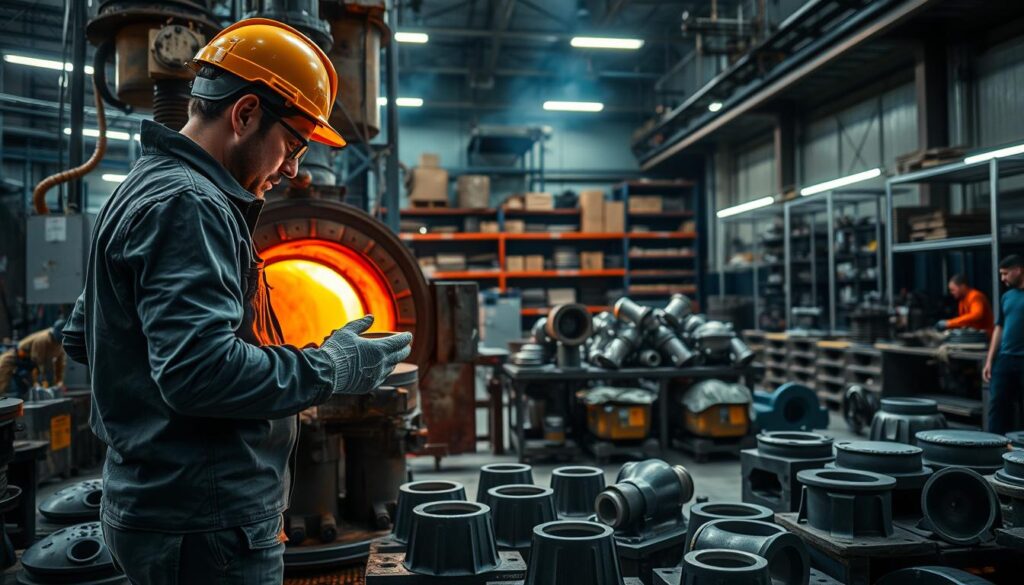
Have you ever thought about how metal parts are crafted with such precision? We owe it all to metal casting. This approach plays a crucial role in creating intricate components for various industries.
Casting involves the process of pouring molten metal into a mold to create the desired shape. It’s wonderful for creating parts with intricate shapes with precision. Precision and strength are crucial in the construction of cars, planes, and buildings.
The casting process allows us to create components with intricate designs. Understanding the different types of casting and their applications is essential for these industries.
Key Takeaways
- Casting is a method used to create intricate metal components.
- It’s about pouring molten metal into a mold to get the shape right.
- This method is very important in car and plane making.
- There are many types of casting, making it versatile.
- Casting assists in creating components with accurate details.
Introduction to Casting
Casting involves melting metal and allowing it to solidify in a mold, creating a new shape. This approach plays a crucial role in creating intricate shapes and components across various industries.
What Is Casting?
Casting involves taking molten metal and pouring it into a mold, allowing it to cool and solidify into shape. It takes on the shape of the mold. The definition of casting includes a variety of techniques and materials, allowing for a wide range of creations.
First, a mold is created to resemble the final product. Next, the molten metal is carefully poured into the mold. Once the metal has cooled down, it is removed and may require additional processes such as machining.
How the Casting Process Works
Creating a mold is the first step in the casting process. This mold is created from a model of what we aim to produce. Next, the molten metal pours into the mold, filling it up entirely.
As it cools down, the metal takes on the shape of the mold, becoming solid and defined. The time it takes for the casting to cool varies based on its size and the material used. After it has cooled and hardened, the metal is taken out of the mold.
History and Evolution of Casting
Casting has a rich history that dates back to ancient times. Regions such as Mesopotamia, Egypt, and China made use of it. In the past, casting was straightforward and had its restrictions.
Thanks to advancements in technology and materials, casting has really evolved. Currently, we have options like sand casting, investment casting, and others. Every method has its own strengths, suited for various tasks and materials.
| Casting Method | Material | Complexity | Cost |
|---|---|---|---|
| Sand Casting | Metals (Ferrous, Non-Ferrous) | Medium to High | Moderate |
| Investment Casting | Metals (Ferrous, Non-Ferrous) | High | High |
| Die Casting | Non-Ferrous Metals | High | Low to Moderate |
The casting process has seen significant improvements. Improvements in molds, melting techniques, and materials have made a positive impact. We are now able to create detailed and high-quality parts for a variety of industries.
Key Principles of Casting
Casting involves a series of important steps that can be quite intricate. Every step plays a crucial role in ensuring the final product is of high quality.
Melting and Pouring
The initial stages involve melting and pouring. The metal is warmed until it melts, and then it’s carefully poured into a mold. The quality of the molten metal really matters.
Managing temperature is crucial. Excessively heated metal can lead to imperfections. If it’s too cold, the mold won’t fill correctly.
Mold Design
The design of the mold plays a crucial role as well. The design should enable the metal to flow smoothly, shrink appropriately, and be easily taken out. A well-thought-out mold design can significantly enhance the quality of the casting.
In the process of designing a mold, it’s important to take into account aspects such as the material of the mold, its shape, and how it will vent. The mold’s performance is influenced by these factors.
| Mold Design Factor | Description | Impact on Casting |
|---|---|---|
| Mold Material | The material used to make the mold, such as sand or metal. | Affects the surface finish and dimensional accuracy. |
| Mold Geometry | The shape and design of the mold cavity. | Influences the flow of molten metal and solidification. |
| Venting | The provision for gases to escape during casting. | Reduces the risk of porosity and gas defects. |
Solidification and Cooling
The processes of solidification and cooling play a crucial role. As the metal cools down, it solidifies and takes on the shape of the mold. The rate at which the casting cools has an impact on its properties.
“The control of solidification is critical for achieving the desired mechanical properties in castings.” –
Foundry Industry Expert
Managing cooling rates is essential. Quick cooling can lead to a more refined microstructure. When cooling happens more slowly, it results in a coarser microstructure.
Pattern Making Basics
Pattern making is all about crafting a copy of the casting you want to achieve. This design is utilized to create the mold. The accuracy of the pattern is essential for the dimensions of the casting.
Patterns can be crafted from various materials such as wood, metal, or plastic. They are a bit bigger than the final casting to allow for shrinkage.
To wrap things up, getting a good grasp of the principles of casting is really important. This involves the processes of melting, pouring, designing molds, solidifying, cooling, and creating patterns. When manufacturers manage these factors effectively, they can create high-quality castings that have fewer defects.
Types of Casting Processes
Various industries utilize different casting processes. These methods encompass sand casting, investment casting, die casting, and permanent mold casting. Every method brings its unique advantages and is suited for specific tasks.
1. Sand Casting
Sand casting uses tightly packed sand to form a two-part mold (cope and drag). Molten metal is poured into the cavity, where it cools and takes shape. This method is widely used due to its simplicity and flexibility.
Key Benefits:
Low tooling cost and simple setup
Works with almost all ferrous and non-ferrous metals
Suitable for small to extremely large parts
Easy post-processing despite lower dimensional accuracy
Common Uses: Pistons, valves, bearings, engine blocks, machinery parts
2. Investment Casting (Lost Wax Casting)
This process uses wax patterns coated with ceramic material. When heated, the wax melts away, leaving a smooth cavity for molten metal. It is ideal for detailed and high-precision parts.
Key Benefits:
Excellent surface finish and fine grain structure
High dimensional accuracy (±0.1 mm)
Allows complex shapes, thin walls, and internal features
Common Uses: Aerospace components, medical implants, automotive engine parts
3. Die Casting
Die casting forces molten metal into hardened steel molds under high pressure. It is best suited for mass production of non-ferrous metal parts.
Key Benefits:
High accuracy and repeatability
Minimal post-machining
Cost-effective for large production volumes
Common Uses: Automotive parts, electrical housings, appliances, machine components
4. Centrifugal Casting
In this method, molten metal is poured into a rotating mold. Centrifugal force pushes the metal outward, creating dense and uniform parts.
Key Benefits:
Very low porosity and shrinkage
No risers needed, reducing material waste
Strong and homogeneous grain structure
Common Uses: Pipes, tubes, cylinders, pressure vessels, sleeves
5. Low-Pressure Casting
Molten metal is gently pushed upward into the mold using controlled air pressure. This smooth filling minimizes turbulence and defects.
Key Benefits:
High casting accuracy and surface quality
Reduced porosity and shrinkage
Ideal for aluminum and other non-ferrous alloys
Common Uses: Wheel hubs, cookware, electronic housings, hollow components
6. Gravity Die Casting
Molten metal flows into a permanent mold using gravity alone, without any applied pressure. It is commonly used for low-melting, non-ferrous metals.
Key Benefits:
Better mechanical properties and surface finish
Low porosity due to smooth metal flow
Simple tooling compared to pressure-based methods
Common Uses: Automotive parts, industrial machinery, household appliances
7. Vacuum Die Casting
This process removes air from the mold before and during casting, preventing air entrapment. It is often used for precision parts and prototypes.
Key Benefits:
High precision with excellent detail
Virtually eliminates porosity
Suitable for thin-walled and complex designs
Common Uses: Medical devices, plastic prototypes, automotive and consumer products
8. Squeeze Die Casting (Liquid Metal Forging)
Molten or semi-solid metal is poured into a die and solidified under high pressure, producing strong and near-net-shape components.
Key Benefits:
Superior mechanical strength
Excellent surface finish
Fast production with fine microstructure
Common Uses: Automotive structural parts, aerospace components, hydraulic parts
9. Lost Foam Casting
A foam pattern is embedded in sand, and molten metal replaces the foam during pouring. The mold is broken after solidification to retrieve the part.
Key Benefits:
Highly complex shapes with minimal machining
Reduced material waste and assembly steps
Compatible with many metals
Common Uses: Engine blocks, pump housings, valves, pipe fittings
10. Continuous Casting
Metal is continuously poured, cooled, and solidified in a steady process. The cast product exits the mold in a consistent shape and length.
Key Benefits:
100% material utilization
Highly automated and efficient
No runners, risers, or sprues required
Common Uses: Beams, rods, billets, slabs, tubes, and strips
Comparison of Types of Casting
| Casting Type | Mold Type | Accuracy & Surface Finish | Cost Level | Suitable Materials | Key Advantages | Typical Applications |
|---|---|---|---|---|---|---|
| Sand Casting | Expendable sand mold | Low–Moderate accuracy, rough finish | Low | Ferrous & non-ferrous | Very low tooling cost, handles large & complex parts | Engine blocks, valves, machinery parts |
| Investment Casting | Expendable ceramic mold | Very high accuracy, excellent finish | High | Steel, aluminum, superalloys | Complex shapes, thin walls, fine details | Aerospace, medical implants, turbine parts |
| Die Casting | Permanent steel die | High accuracy, smooth finish | Medium–High | Aluminum, zinc, magnesium | High production rate, tight tolerances | Automotive parts, housings, appliances |
| Centrifugal Casting | Permanent or expendable mold | High accuracy, dense structure | Medium | Steel, iron, copper alloys | Minimal porosity, strong grain structure | Pipes, tubes, cylinders |
| Low-Pressure Casting | Permanent mold | High accuracy, good finish | Medium | Aluminum & non-ferrous alloys | Controlled filling, low defects | Wheel hubs, cookware, frames |
| Gravity Die Casting | Permanent mold | Moderate–High accuracy | Medium | Aluminum, magnesium, copper | Simple tooling, good mechanical strength | Automotive & industrial components |
| Vacuum Die Casting | Permanent or flexible mold | Very high accuracy | High | Aluminum, plastics, rubber | Eliminates air entrapment, thin walls | Medical parts, prototypes, auto panels |
| Squeeze Die Casting | Permanent die | Very high accuracy | Medium–High | Aluminum, magnesium | Excellent strength, low porosity | Structural automotive & aerospace parts |
| Lost Foam Casting | Expendable foam pattern | Moderate–High accuracy | Medium | Iron, aluminum, steel | No parting lines, complex geometry | Engine heads, pump housings |
| Continuous Casting | Permanent water-cooled mold | Consistent profile accuracy | High (setup) | Steel, aluminum, copper | 100% material yield, automation | Beams, billets, slabs, rods |
Materials Used in Casting
The casting process involves a variety of materials, each bringing its own unique characteristics to the table. The appropriate material is chosen according to the requirements of the final product. This covers aspects such as strength, durability, and its ability to resist corrosion or heat.
Ferrous Metals
Steel and iron, both ferrous metals, are frequently used in the casting process. They possess strength and adaptability. Steel castings excel in handling heavy loads and thriving in tough environments, making them ideal for construction and machinery applications.
Iron castings are recognized for their impressive durability against wear. People frequently use them in car parts.
Non-Ferrous Metals
Aluminum, copper, zinc, and magnesium, which are non-ferrous metals, each come with their unique advantages. Aluminum is lightweight and resistant to corrosion, which makes it a great choice for vehicles like cars and planes. Copper is an excellent choice for electrical components due to its impressive ability to conduct electricity.
Zinc and magnesium are valued for their ability to resist corrosion and their impressive strength-to-weight ratio.
Plastics and Polymers
More and more people are turning to plastics and polymers for casting. They adapt easily and manage chemicals effectively. They can also be blended with additives to achieve the desired properties. These materials find their way into a wide range of things, from the items we use daily to the components in industrial machinery.
Alloys and Composites
Alloys and composites bring together the finest qualities of various materials. Alloys such as stainless steel and brass offer enhanced strength and improved resistance to corrosion. Composites, such as blends of metal or polymers, provide impressive strength while remaining lightweight. These materials find their place in cutting-edge areas such as aerospace and sports gear.
Ultimately, selecting the appropriate materials for casting is essential. The product’s effectiveness, longevity, and price are all influenced by this factor. Understanding the capabilities of each material enables manufacturers to create improved products.
Advantages of Casting
Casting plays an essential role in today’s manufacturing processes. It provides a variety of advantages for various sectors. This is perfect for creating intricate components and managing large-scale production tasks.
Ability to Produce Complex Shapes
Casting allows us to create shapes that are challenging or even impossible to achieve using other techniques. This is incredibly helpful in areas such as aerospace and automotive, where designs can be quite intricate.
Material Versatility
Casting involves a variety of materials, including metals, alloys, and certain polymers. This allows us to choose the most suitable material for every task. This helps make sure our products possess the right qualities.
Cost-Effective for Large Production Runs
Getting everything ready for casting can be quite an investment initially. However, the cost decreases as you produce more parts. The reason for this is that the initial expenses are distributed across a larger number of items.
Suitable for Heavy Components
Casting is an excellent method for creating large, heavy components. It has the capacity to manage a significant amount of molten material. This is perfect for sectors that require large components, such as construction and heavy equipment.
| Advantage | Description | Industry Benefit |
|---|---|---|
| Complex Shapes | Ability to produce intricat geometries | Aerospace, Automotive |
| Material Versatility | Accommodates various materials | All industries |
| Cost-Effective | Economical for large production runs | Mass production industries |
| Heavy Components | Suitable for large, heavy parts | Construction, Heavy Machinery |
Disadvantages of Casting

Although common, the casting process has drawbacks. These include flaws and issues with surface finish. Manufacturers can select more effective production techniques by being aware of these concerns.
Surface Finish Limitations
A major challenge with casting is achieving a smooth surface. The quality of the surface is influenced by the mold, the way the material is poured, and how it cools down. For instance, sand casting typically results in a coarser finish compared to investment casting.
Enhancing Surface Finish: Shot blasting or opting for finer mold materials can lead to a smoother surface. However, these methods might also lead to higher expenses.
Dimensional Tolerance Issues
Obtaining accurate dimensions with casting can be quite challenging. Variations in molds, shrinkage, and various other factors can lead to issues with size.
Improving mold design and being meticulous with casting can make a significant difference in tolerance control. However, it requires a significant amount of skill and financial resources.
Defects: Porosity, Shrinkage, Cracks
Some typical issues that can arise in casting include porosity, shrinkage, and cracks. Porosity occurs due to gas being trapped, shrinkage happens as materials cool, and cracks develop from thermal stress.
| Defect Type | Cause | Prevention Method |
|---|---|---|
| Porosity | Gas entrapment | Proper degassing, controlled pouring |
| Shrinkage | Cooling and contraction | Riser design, controlled cooling |
| Cracks | Thermal stresses | Uniform cooling, stress relief |
High Energy Consumption
Just like melting metals, casting requires a significant amount of energy. This increases expenses and negatively impacts our environment.
Improving furnace efficiency, embracing eco-friendly melting technology, and implementing smart scheduling can significantly reduce energy consumption.
Applications of Casting
In various industries, casting plays a crucial role as it allows for the creation of intricate shapes. It can be utilized for everything from tiny components to large equipment. This really adds to its versatility.
Automotive and Transportation
In vehicles, casting is used to create engine blocks and cylinder heads. It’s essential for today’s engines to function effectively. Aluminum and iron castings are popular choices due to their durability and ability to withstand high temperatures.
Professionals emphasize that casting plays a crucial role in the production of car parts. It contributes to making cars quicker and more lightweight. Casting is utilized for components like transmission parts and gearboxes.
Aerospace and Defense
The aerospace industry requires casting for turbine blades and engine components. Investment casting is wonderful for these applications as it allows for the creation of intricate shapes and smooth finishes.
In aerospace, the quality of materials and manufacturing processes is crucial. This helps make sure that aircraft parts are both safe and dependable. People often turn to advanced alloys and composites.
Construction and Infrastructure
In construction, casting is used to create various building components and decorative elements. Concrete casting plays a vital role in creating elements like columns and facades.
Casting is also found in infrastructure, such as components for bridges and roads. Cast components are strong and adaptable, meeting a variety of construction requirements.
Electronics and Electrical Components
In the world of electronics, casting is used to create components such as housings and connectors. It’s great for creating parts that are both precise and smooth. This is essential for electronic devices to function properly.
Heat sinks in electronics are also made through casting. These components play a crucial role in regulating heat within devices. People often prefer aluminum casting because it does a fantastic job of conducting heat.
Casting Defects and Prevention
Issues with casting can significantly impact the overall quality of a product. Understanding potential defects and how to prevent them is crucial. Common issues include defects such as porosity, shrinkage, and mold shift.
Common Casting Defects
Porosity occurs when gas bubbles become trapped within the metal. As the metal cools down, it can create cavities or holes due to shrinkage. Mold shift happens when the mold isn’t properly aligned, resulting in uneven castings.
Prevention Methods
There are ways to prevent these issues. Effective mold design and careful pouring are essential. Additionally, allowing the metal to cool gradually is really beneficial. These methods allow for the creation of castings that meet high standards.
FAQs
What is casting, and how does it work?
Casting is a way to make things by pouring liquid material into a mold. This liquid is usually metal or alloy. It’s heated until it melts, then poured into the mold to solidify and take shape.
What are the different types of casting processes?
There are many casting processes, like sand casting and investment casting. Each has its own benefits and is best for certain materials and jobs.
What materials can be used in casting?
Many materials can be cast, including metals like steel and aluminum. Also, plastics, polymers, alloys, and composites can be used.
What are the advantages of casting?
Casting is great for making complex shapes and is versatile. It’s also cost-effective for big batches and works well for heavy parts.
What are the common defects in casting, and how can they be prevented?
Defects like porosity and shrinkage can happen. To avoid them, design the mold well, control cooling, and make patterns carefully.
What are the applications of casting in various industries?
Casting is used in many fields, like cars, planes, buildings, and electronics. It makes engine parts, gears, and architectural details.
How is sand casting different from investment casting?
Sand casting uses sand molds, while investment casting uses ceramic ones. Sand casting is cheaper but less precise. Investment casting is more detailed and precise.
What is die casting, and when is it used?
Die casting uses metal molds for precise parts. It’s good for small to medium parts with complex shapes. It’s used in cars and electronics.
How does permanent mold casting work?
Permanent mold casting uses a metal mold that can be reused. It’s coated to prevent sticking. The mold is made to last many uses.