
Ceramic CNC Machining

Can advanced manufacturing technologies make it easier to work with hard and brittle materials like ceramics? Yes, through Ceramic CNC Machining. This method uses computer numerical control to shape ceramic parts with great accuracy.
This technology is very important for businesses that need to make complicated shapes with very small tolerances. Think of medical and aerospace equipment. Makers can make parts that are both high-quality and accurate with CNC tools and software.
With ceramic CNC machining, you can make detailed parts out of ceramic materials. It’s hard to work with these materials because they are hard and brittle.
Key Takeaways
- Using CNC technology to shape ceramic materials with great accuracy.
- Parts of high quality with complicated shapes and tight tolerances.
- Aerospace and medical devices are two fields that can use this technology.
- CNC machines and software make sure that specifications are accurate and strict.
- Ceramic CNC Machining solves the problems that come up when working with hard and brittle materials.
Introduction to Ceramic CNC Machining
CNC machining of ceramics is a big step forward in making things. It lets us make very precise ceramic parts that are very complicated. It is now faster and more accurate to make things thanks to this technology.
What is CNC machining for ceramics?
Ceramic Computer numerical control (CNC) technology is used in CNC machining to shape ceramics. First, we make a design on a computer. The CNC machine then uses these steps to make the part.
This is the best way to make parts with shapes that are hard to make. Old methods make it hard or impossible. CNC lets us make very precise designs with lots of detail.
Why Use CNC for Ceramics Instead of Other Ways
CNC machining is great for ceramics because it can make parts with very precise and complicated shapes. It’s better than other ways because it’s more accurate and consistent. This is important when parts need to fit together perfectly.
CNC machining is also quick and doesn’t need expensive molds or tools. This makes it cheaper for making both small and big batches of parts.
| Method | Precision Level | Complexity | Cost-effectiveness |
|---|---|---|---|
| CNC Machining | High | High | High |
| Traditional Machining | Medium | Medium | Medium |
| Casting | Low | Low | High |
The table shows the good things about CNC machining. Compared to other methods, it’s better for accuracy, complexity, and saving money.
Materials Used in Ceramic CNC Machining

There are many different types of ceramic CNC machining materials, each with its own set of properties. The right material choice can change how well the product works, how long it lasts, and how much it costs.
Common Types of Ceramic Materials
People often use materials like alumina, zirconia, and silicon nitride. Alumina, or aluminum oxide, is hard and doesn’t wear down easily, making it great for parts that need to last. Zirconia (Zirconium Oxide) is strong and tough, making it great for hard environments. Silicon nitride is great for high-temperature uses because it can handle thermal shock.
Characteristics of machinable ceramics
The machinability of ceramics depends on their properties. Hardness, wear resistance, thermal stability, and mechanical strength are all important traits. Alumina and silicon carbide are two types of ceramics that are very hard. This makes them great for parts that need to be resistant to wear. Zirconia is a great material for parts that need to be very strong mechanically because it is tough.
Things to think about when choosing materials
You need to think carefully about which ceramic material to use for CNC machining. Things to think about are the application, the environment, and the mechanical properties that are needed. In aerospace, materials that can withstand high temperatures and wear are best. In medicine, biocompatibility and strength are essential. Knowing these needs helps pick the best ceramic material.
The Ceramic CNC Machining Process
To make great ceramic parts, manufacturers need to get the CNC machining right. This means changing a lot of settings. The whole process is hard to understand and requires a lot of knowledge about the methods and factors involved.
Methods of Machining
Ceramic There are different ways that CNC machining shapes and polishes ceramic materials. Some of these are:
- Milling: This method uses spinning cutting tools to take material away from the ceramic piece.
- Grinding: It uses wheels with rough edges to get a very smooth finish.
- Diamond Tooling: Tools with diamond coatings are used because they are strong and sharp, which is important for hard ceramics.
Optimizing machining parameters
Getting the machining settings right is important for a good finish, accuracy, and less wear on the tools. Some important things to think about are:
- Cutting speed: The speed at which the tool touches the workpiece.
- Feed Rate: How quickly the workpiece goes into the tool.
- Depth of Cut: The amount of material removed in one pass.
Finding the right balance is what changing these settings is all about. It’s important to take off as much material as possible without hurting the tool or the ceramic.
Managing heat, cooling, and lubrication
Good cooling and lubrication keep things from getting too hot, reduce friction, and improve the finish. Thermal management keeps the size stable and protects the ceramic part from damage.
Holding, controlling vibrations, and fixing things
To keep the ceramic piece steady and cut down on vibration and movement during machining, it’s important to use the right workholding and fixturing. This is essential for precision and avoiding damage to the part.
Advantages of Ceramic CNC Machining
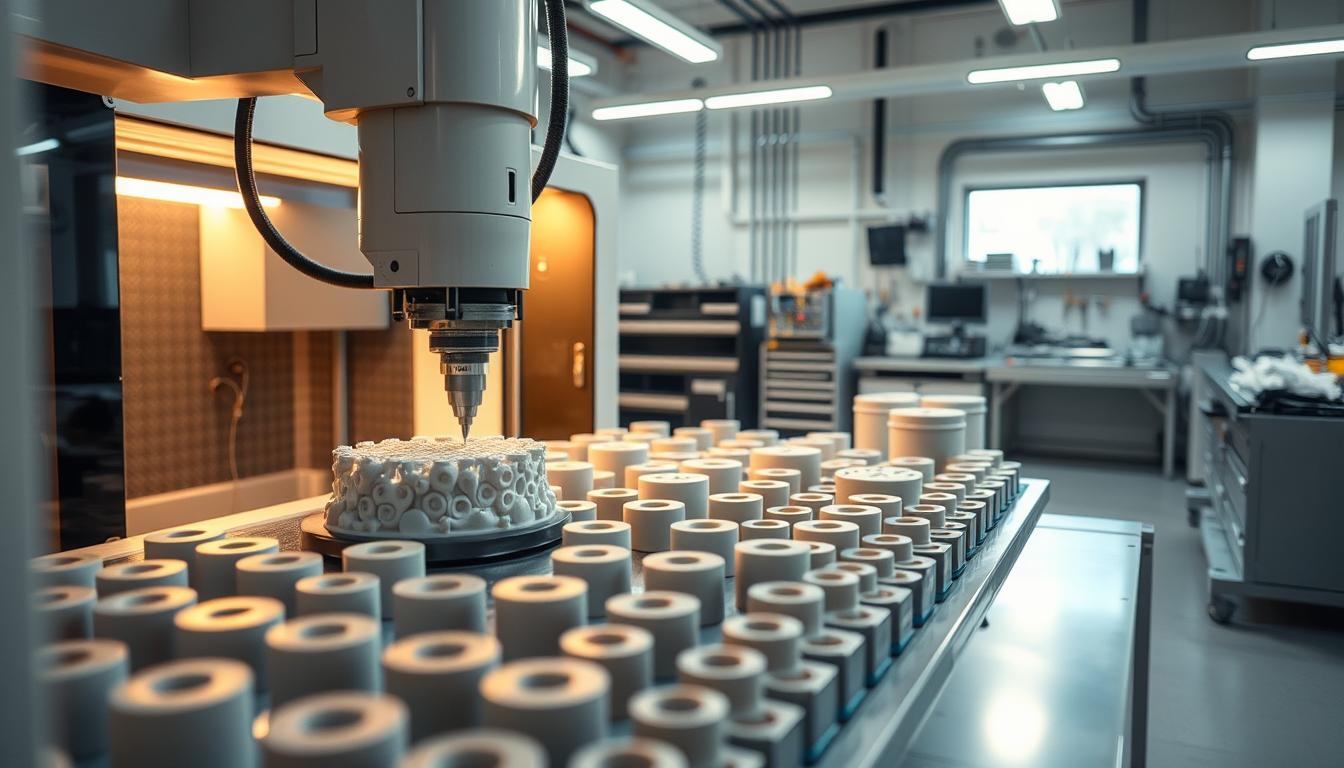
CNC machining for ceramics is the best way to make parts that are exact and detailed. It’s great for making things of high quality. This method is great for people who need parts that are exact and detailed.
High Precision and Tight Tolerances
This method is known for being very accurate and having very tight tolerances. It’s very important for fields like aerospace and medical devices. Here, being right is important.
Making Complicated Shapes
Ceramic CNC machining can easily make shapes that are hard to make. This gives you more choices for how to design. It’s something that other methods can’t do as well.
Cost-Effectiveness and Scalability
This method can be used on a large scale and doesn’t cost much. It works well for both small and large batches. This makes it useful for a wide range of production needs.
Strength, resistance to wear, and long life
Ceramic parts made with CNC methods are strong, last a long time, and don’t wear out easily. They’re perfect for tough environments and high-demand applications.
| Advantage | Description | Benefit |
|---|---|---|
| High Precision | Achieving tight tolerances and accurate dimensions | Ideal for critical applications |
| Complex Geometries | Ability to produce intricate designs | Enhanced design possibilities |
| Scalability | Flexible production for small and large batches | Cost-effective for various production needs |
| Cost-Effectiveness | Reduced cost per unit for large production runs | Economic benefits for high-volume production |
Challenges & Limitations
There are a lot of good things about ceramic CNC machining, but there are also some problems. These limits can make it less efficient and more expensive.
Brittleness and the possibility of breaking or chipping
Ceramic materials are weak, so they can crack or chip easily. This can make the scrap rate go up and the quality of the product go down.
Manufacturers use special tools and machining methods to cut down on damage.
Wear and tear on tools, especially diamond tools
Tool wear is a major problem in CNC machining of ceramics. Diamond tools wear out quickly because ceramic is rough. This can make tools more expensive and shorten their lives.
Using high-quality materials and coatings on tools can help them last longer and wear less.
Low rate of material removal (MRR)
Ceramic materials have a low rate of material removal (MRR). This means that machining takes longer and costs more. Ceramics are hard to machine because they are hard and brittle.
Using better machining parameters and more advanced methods can raise MRR and cut down on machining times.
Cost of Investment
The cost of buying CNC equipment and training can be a big problem at first. The cost of specialized tools and equipment for ceramic machining is high.
| Challenge | Description | Mitigation Strategy |
|---|---|---|
| Brittleness | Risk of cracking or chipping | Specialized machining techniques and tooling |
| Tool Wear | Abrasive nature of ceramics | Advanced tool materials and coatings |
| Low MRR | Prolonged machining times | Optimizing machining parameters |
| Investment Cost | High initial investment | Careful cost-benefit analysis |
To sum up, ceramic CNC machining has a lot of pros and cons. Manufacturers can make their processes better and get better results by knowing about these problems and using good strategies.
Design Considerations & Best Practices

It is hard to design for ceramic CNC machining. It means thinking about how easy it is to make, how much stress it can take, and how to design the fixture. Following best practices is important if you want to make high-quality ceramic parts. These steps make design easier, lower stress, and make sure that parts are held tightly.
Design for Manufacturing (DFM) for Ceramics
Design for Manufacturability (DFM) is very important when it comes to ceramic CNC machining. It means making designs less complicated and less expensive. DFM helps makers stay away from features that make machining hard, like shapes that are hard to work with or parts that are too thin and can break easily.
Making designs easier can cut down on the number of steps needed to machine them. This means that production will take less time and money. Simplifying the design of ceramic parts also makes them stronger and more reliable.
Avoiding Stress Concentration
When making ceramic parts, you should try to avoid stress concentration. Parts can break or fail during or after machining if they are under stress. To avoid stress points, designers should get rid of sharp corners and sudden changes in thickness.
Using smooth transitions and rounded corners can make it less likely that something will go wrong. Finite element analysis (FEA) can also help by simulating stress in parts. This helps find and fix places where stress builds up before making the part.
Designing Fixtures and Strategies for Clamping
For ceramic part machining to work, it is important to have good fixture design and clamping strategies. The fixture must hold the ceramic securely without breaking it. You need to think about the clamping forces and where they touch the part.
Soft-jaw chucks or special fixtures for delicate materials might be good ways to clamp things. Using the right support and clamps lowers the risk of damage during machining.
Inspection and Quality Control
Ceramic CNC machining needs a lot of inspection and quality control. After machining, parts must be checked to make sure they meet specifications and tolerances. This means checking things like size, surface finish, and more.
Strict quality control and inspections help find and fix problems early. This ensures ceramic parts are of high quality and meet customer needs.
Applications
Many fields, such as aerospace and electronics, use ceramic CNC machining. It makes shapes that are hard to understand and sizes that are exact. Ceramic parts are perfect for tough environments because they are accurate and long-lasting.
Aerospace and Defense
Because they are so strong and can handle very high and low temperatures, ceramic parts are highly valued in the aerospace and defense industries. Ceramic CNC machining makes parts that can handle tough conditions and are very detailed. This is why they are so useful in aerospace.
Health and dental
Ceramic CNC machining is used in medicine and dentistry because it is biocompatible and strong. Ceramic parts are used in medical devices like dental implants, surgical tools, and more. Here, accuracy and dependability are very important.
Electronics and semiconductors
Ceramic CNC machining is very important in the fields of electronics and semiconductors. People use ceramics because they are good at insulating electricity. CNC machining makes sure that ceramic parts meet strict industry standards.
Energy and Industry
Ceramic parts are useful in industry because they don’t wear out easily and can handle tough conditions. Ceramic CNC machining makes parts that work well in tough and hot conditions.
Ceramic CNC machining is useful and flexible in a wide range of fields, from aerospace to industrial. It allows for the creation of high-precision, durable components, benefiting various sectors.
Cost Analysis

Manufacturers need to know how much ceramic CNC machining costs. It helps them make more things. There are a few important things that affect the cost of making ceramic parts with CNC machining.
Things that affect costs
Material costs, machining time, and tool wear are the main things that drive up costs. The price of ceramic materials can change a lot. This is because ceramics like zirconia and silicon nitride are more expensive.
- Material costs: The price of ceramic materials, which can be high because they are hard to make.
- Time spent machining: The longer the machining process takes, the more it costs because it uses more machines and workers.
- Tool wear: Because ceramic materials are hard and rough, they wear down tools quickly, especially diamond tools.
Strategies for Lifecycle Costs
Using lifecycle cost strategies can make owning a product less expensive overall. It’s not just about the initial cost. It also covers the costs of upkeep, repairs, and replacements over time.
One way to save money in the long run is to choose materials and designs that do. Also, buying tools that will last and making production more efficient can help.
Optimizing for the size of the batch and the amount of production
To save money, it’s important to find the right batch size and production volume. Making more parts at once can lower the cost of each part. But, it can also lead to higher inventory costs if the parts aren’t used quickly.
Manufacturers need to make a compromise. They should try to get economies of scale, but they should also be able to change to meet customer needs.
- Economies of scale: Making more of something to lower the cost per unit.
- Managing stock levels to keep holding costs as low as possible is called inventory management.
- Flexibility means being able to change how much you make based on how much people want it.
Quality Control & Inspection
Strict quality control is what makes ceramic CNC machining accurate and dependable. It’s important to make sure that ceramic parts meet the standards. This is very important for how well they work in different situations.
Checking Dimensions
Dimensional inspection is a very important part of quality control for CNC machining of ceramics. It makes sure the parts are within the tolerances that have been set. This step checks that the parts fit and work as they should.
People often use Coordinate Measuring Machines (CMMs) for this. They give the exact sizes of the part. We can check to see if the parts fit the design specs with this.
Finish and roughness of the surface
The finish and roughness of ceramic parts are very important. A smooth surface can reduce wear and tear and friction. But a rough surface can make things worse.
You can check the surface finish in a few different ways. Some of them are profilometry and surface roughness testing. These methods help us check to see if the surface is good enough.
Stress that is left over and defects below the surface
Ceramic parts can become weaker because of residual stress and subsurface defects. You should check these to make sure the parts are strong and will last a long time.
We use X-ray diffraction to find out how much stress is left over. Ultrasonic testing can find problems below the surface. These methods give a full view of the part’s quality.
Final Thoughts
CNC machining of ceramics has changed what can be done with hard and brittle materials. Manufacturers can now make parts with amazing accuracy, durability, and performance that were impossible with traditional methods by combining the advanced properties of ceramics with the precision of CNC technology.
CNC machining gives ceramics a whole new level of engineering value. For example, aerospace parts that need to be able to handle extreme temperatures and medical devices that need to be perfectly biocompatible. There are still problems like brittleness, tool wear, and higher machining costs, but improvements in tooling, multi-axis machines, automation, and hybrid manufacturing are slowly making these problems less of a problem.
CNC machining is still one of the most reliable and scalable ways for businesses and engineers to get high-precision, high-performance ceramic parts. Ceramic CNC machining makes parts that work well in modern applications when the right materials are chosen, smart design practices are used, and quality control is strict. This sets the stage for even more innovation in the future.