
CNC Machining Bronze
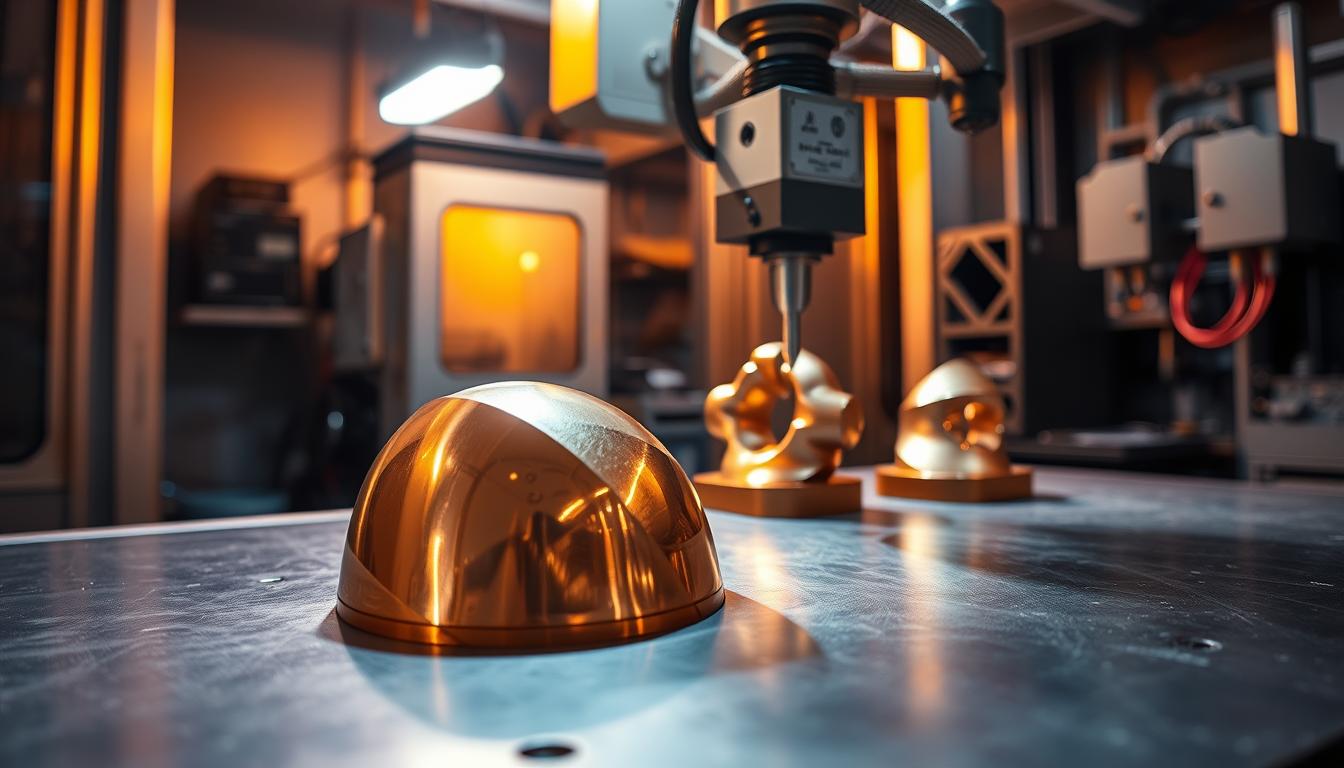
What is it about bronze that makes it a great material for a wide range of industrial uses, from marine engineering to complicated machinery parts?
People have loved bronze, a mix of copper and tin, for hundreds of years because it lasts a long time and doesn’t rust. It was first used around 3000 B.C., which was a big step forward in technology. CNC machining now improves bronze’s natural properties, making it possible to make very precise parts that are very complicated.
Bronze is important in today’s industries because it can handle tough conditions. This makes it a very important material in places where failure is not an option.
Key Takeaways
- Bronze is a strong copper-tin alloy that is used in many different industries.
- CNC machining makes bronze’s natural properties better for making precise parts.
- Bronze is great for marine engineering because it doesn’t corrode.
- The alloy’s strength is very important for use in harsh environments.
- Bronze has been an important material for hundreds of years.
Introduction to Bronze CNC Machining
Copper and tin are mixed together to make bronze. It works well for CNC machining because it can do a lot of things. This method makes very precise bronze parts that are very complicated and meet a lot of industrial needs.
What Is Bronze? — The Different Types and Composition of Alloys
Copper and tin make up most of bronze. The properties change depending on how much of each is used. You can make different kinds of bronze by adding things like aluminum or silicon.
Leaded bronze is easy to work with, and phosphor bronze is strong and lasts a long time. To choose the right bronze for a job, you need to know what the alloy mix is.
Why Use CNC to Work with Bronze?
CNC machining is great for bronze because it can make complicated shapes and is very accurate. It makes sure the product is perfect and doesn’t waste much.
There are many benefits to using CNC to machine bronze. It works quickly, makes detailed designs, and has great dimensional accuracy. These reasons make CNC machining perfect for making bronze parts for tough jobs.
Types of Bronze Alloys for CNC Machining

CNC machining uses different bronze alloys because each one has its own strengths. The right alloy depends on how strong it needs to be and how well it resists corrosion. It also depends on what the part is meant to do.
Bronze with Lead
CNC machining works best with leaded bronze. It is easy to work with and doesn’t wear out easily. The lead makes it easy to machine at high speeds, which is great for parts that are hard to make.
People often use it for bushings, bearings, and other parts that don’t wear out easily.
Bronze with Phosphor
Phosphor bronze is strong, doesn’t get tired easily, and has great spring properties. It is strong because of the phosphorus, which makes it great for springs, electrical contacts, and connectors. It also doesn’t rust easily, which makes it useful.
Bronze made of aluminum
Aluminum bronze is strong, doesn’t rust, and conducts heat well. Aluminum adds a layer of oxide that protects against corrosion. It’s great for things like marine hardware, power generation parts, and more.
Bronze with silicon
People like silicon bronze because it is very strong, doesn’t rust easily, and can be welded well. Silicon makes it stronger and more durable. It’s great for parts, fasteners, and structural components that are in places where they can rust. People also use it because it’s beautiful in architecture and decorations.
In short, the right bronze alloy for CNC machining depends on what the project needs. This includes how the part works, the conditions in which it will be used, and how it will be used. Knowing each alloy’s characteristics helps manufacturers pick the best material for their projects.
Mechanical & Physical Properties of Bronze
People know that bronze is strong, long-lasting, and doesn’t rust easily. These qualities make it useful in today’s manufacturing. It’s great for tough places.
Strength and Toughness
Bronze alloys are tough and strong. This is important for applications that need to last a long time and not wear out. The alloy gives it strength, and tin and aluminum are important parts of that.
- High Strength: Bronze can handle a lot of stress and weight.
- Hardness: It doesn’t wear down or change shape easily.
Low friction and wear resistance
Bronze is great because it doesn’t wear out easily and doesn’t make things slippery. It’s great for things that move a lot. Adding lead can make it even better at lowering friction.
Thermal and electrical conductivity
Bronze alloys are good at conducting heat and electricity, but not as well as pure copper. The kind of bronze affects how well it works.
“The thermal conductivity of bronze makes it suitable for applications where
heat dissipation is critical.”
Resistant to corrosion
Bronze doesn’t rust easily, even in tough places like seawater. This is because there is a protective oxide layer on its surface.
- Bronze is great for marine uses because it doesn’t rust in seawater.
- Corrosion Protection: It keeps bronze parts from rusting in tough places.
Machining Techniques for Bronze

Manufacturers use a number of methods to machine bronze with accuracy. They all have their own pros and cons. Bronze is strong, doesn’t rust, and can be shaped into complicated shapes. It is mostly made of copper and tin.
Milling (3 to 5 axes)
Milling is a great way to make bronze parts that are hard to make. 3-axis milling is good for making shapes that are simple. 5-axis milling is better for parts that have a lot of curves and angles.
It depends on the design and complexity of the part whether to use 3-axis or 5-axis milling. 5-axis milling is more accurate and flexible for detailed designs.
Lathe and turning work
Turning is the best way to make round, symmetrical bronze parts. To cut away material, the workpiece must be turned while a tool moves along the axis.
Turning operations can get a high finish. They work well for making bearings, bushings, and other round parts.
Drilling and Tapping Bronze
Drilling and tapping are important steps in making holes and threads in bronze. Drilling makes a hole, and tapping makes threads inside it.
It’s important to pick the right taps and drill bits. It makes sure everything is correct and keeps the bronze safe.
EDM (Electrical Discharge Machining)
EDM gets rid of bronze by using electrical discharges. It’s great for making holes and shapes that are hard to make. These things can’t always be done the old-fashioned way.
EDM is also good for parts with lots of small details or for cutting hard materials.
Best Practices & Tips for CNC Machining Bronze
When CNC machining bronze, it’s important to follow some important rules to get the best results. These methods make the parts better and speed up the machining process. Bronze is a useful metal that needs to be worked with carefully to get the most out of it.
Finding the best cutting parameters (speed, feed, depth)
Getting the cutting settings right is very important for CNC machining bronze. The tool’s life and the finish on the part’s surface depend a lot on the right combination of speed, feed rate, and depth of cut.
- Speed: Faster speeds can make the surface finish better, but they can also make the tool wear out faster. Finding the right speed is very important.
- The feed rate affects the chip load, the life of the tool, and the quality of the surface. A feed rate that is well-balanced is very important.
- Cutting Depth: The depth of the cut affects how well the machine works and how long the tool lasts. If it’s too deep, the tool wears out faster; if it’s too shallow, it’s not useful.
The angles of the rake and relief on the tool
In machining, the shape of the tool is very important. The right rake and relief angles make tools work better and last longer.
Rake Angle: A positive rake angle can make cutting forces smaller and the surface finish better, but it might make the tool edge weaker.
Relief Angle: The relief angle is important for lowering the friction between the tool and the workpiece, which stops too much wear.
Chip Control and Evacuation Plans
For a clean and efficient machining environment, it is very important to be able to control and evacuate chips. It’s important to use the right chip breakers and make sure there is enough coolant flow to get rid of chips.
Stress Relief and Heat Treatment (Annealing)
After machining, bronze parts can be stress-relieved and heat-treated, like annealing. These processes help with machinability and relieve stress inside the machine.
- Annealing: This is the process of heating the bronze to a certain temperature and then letting it cool down. It relieves stresses and improves ductility.
Tolerances & Surface Finishes in Bronze CNC Machining

Getting the right balance is very important when machining bronze with a CNC machine. This balance is between tolerances and how the surface looks. We can make complicated bronze parts with exact tolerances and surface qualities thanks to CNC machining’s precision.
Normal Tolerance Ranges
CNC machining of bronze can be very exact. The tolerances are between +/− 0.001 and +/− 0.005 inches. For parts to fit and work properly, this level of accuracy is necessary.
- Tight tolerances: +/- 0.001 inches for very precise uses
- For most industrial uses, the standard tolerances are plus or minus 0.005 inches.
- Loose tolerances: for less important dimensions, they are plus or minus 0.01 inches.
Options for Surface Roughness and Finishing
The finish on the outside of CNC-machined bronze parts can change. It depends on how the machining is done and if there are any extra steps to finish it. Most of the time, surface roughness values are between 32 and 125 microinches Ra.
There are a lot of different ways to make the surface of bronze parts better. Some of these are:
- Grinding: For smooth surfaces and exact sizes
- Polishing: To make something shiny
- Sandblasting: To get a smooth, even finish
After Processing: Patination, Coatings, and Lacquering
CNC-machined bronze parts can look and work better after post-processing. Some common ways are:
- Patination: A chemical process that changes colors and textures
- Coatings: Layers that protect against corrosion better
- Lacquering: A clear coat that protects the finish and keeps it from tarnishing.
If you choose and use these post-processing methods carefully, you can get bronze parts that look and work the way you want them to.
Advantages of CNC Machining Bronze
CNC machining makes bronze better for different uses. It makes shapes that are hard to understand and sizes that are exact. These are very important in a lot of fields.
High Accuracy and Precision in Dimensions
CNC machining bronze parts are very accurate and precise in terms of size. This is very important for applications that need very small tolerances. Advanced CNC machines are very good at following complicated designs.
This level of accuracy means that the parts fit perfectly. It cuts down on the need for extra machining or changes when putting things together.
Great machinability and tool life
CNC machining works great with bronze. It makes tools last longer. This makes tools last longer and lowers the cost of making things.
It is also easier to work with, which speeds up production. Bronze can be cut and shaped quickly without harming tools or material.
| Property | Benefit |
|---|---|
| High Precision | Ensures accurate fits and reduces assembly adjustments |
| Excellent Machinability | Extends tool life and reduces production costs |
| Wear Resistance | Enhances the durability of the parts |
| Corrosion Resistance | Makes bronze suitable for harsh environments |
Resistance to wear and low friction behavior
Bronze alloys don’t wear out easily and don’t create a lot of friction. This is why they work well in situations where parts move. It makes parts last longer.
Resistance to corrosion in harsh environments
Bronze is great because it doesn’t rust easily. It’s great for tough places like the ocean or chemical plants. This keeps parts working well over time, even when they are in corrosive environments.
In short, CNC machining bronze is a great choice for many industrial needs. It’s used in marine parts and power generation, among others.
Challenges & Limitations of Machining Bronze

There are a number of problems that come up when you use CNC machines to work with bronze. Bronze lasts a long time and doesn’t rust. But its special features make it hard to work with machines.
Problems with worn tools and built-up edges
One big problem is that tools wear out. Bronze can be rough, which makes tools wear out quickly. This not only shortens the life of the tool, but it also changes the finish on the part’s surface. Another problem is built-up edge (BUE), which happens when bronze particles stick to the tool and change its shape, making it the wrong size.
Using carbide tools with a coating can help them last longer. A study showed that coated tools last longer and perform better:
| Tool Material | Wear Rate (μm/min) | Tool Life (min) |
|---|---|---|
| Uncoated Carbide | 0.15 | 60 |
| Coated Carbide | 0.08 | 120 |
| High-Speed Steel | 0.25 | 30 |
Risks of Work Hardening
When you work with bronze, it can get harder and more brittle. This is called “work hardening.” It makes the material more likely to crack and wears out tools faster.
“Work hardening is a critical factor to consider when machining bronze. It can
significantly impact the machinability and the final properties of the component.” –
Source: Advanced Machining Techniques
Making Heat and Changing Shape with Heat
Making bronze into something else makes a lot of heat. This heat can make things look different because of thermal distortion. This kind of distortion can make parts the wrong size. It’s important to cool the material down well and carefully change the cutting parameters to avoid this.
Problems with high material costs and density
Bronze costs more than other metals like steel or aluminum. Because it is so dense, it takes more energy to machine it. Because of its weight, this can be hard to deal with.
Manufacturers might make parts that use less material to fix these problems. They also choose the right bronze alloy for each job.
Industrial Applications of CNC Machined Bronze Parts
Many businesses use bronze parts that have been CNC machined. They last a long time and don’t rust easily. This is why bronze is great for parts that have to deal with tough conditions.
Uses in the Marine and Maritime Fields
For pumps, valves, and other things in the marine world, bronze is very important. It doesn’t rust when it’s in seawater. It’s strong and doesn’t create much friction, which makes it great for these tasks.
Parts for turbines and power generation
Bronze is also a great choice for parts for turbines and other things that make power. It can handle high temperatures, is strong, and lasts a long time. This makes it very useful in this area.
Bearings, bushings, and parts that slide
CNC machined bronze is the best choice for bearings, bushings, and sliding parts. It doesn’t wear down quickly and has low friction. This means you won’t have to replace or fix things as often, which saves you money.
CNC machining makes sure that bronze parts are exact and correct. This meets the high standards of many industries.
Final Thoughts
Bronze has been around for a long time, from tools used in ancient times to high-precision industrial parts made today. It has a natural mix of strength, resistance to corrosion, and great wear properties that make it useful in many industries. When used with CNC machining, bronze gets even stronger. Modern CNC technology can do things that traditional methods can’t, like work with tight tolerances, repeatable accuracy, and complicated shapes.
Machining bronze can be hard because tools wear out, heat is made, and the work hardens. But these problems can be solved by using the right cutting parameters, tools, and chip control. The end result is a combination of materials and processes that can make parts that last a long time and work very well.
CNC-machined bronze is very important in places where reliability is a must, like marine environments, power generation systems, bearings, bushings, and precision sliding parts. As industries keep asking for stronger, longer-lasting parts, bronze is still a good choice. CNC machining makes it even more useful and reliable.