
What is Compression Molding? Details Explained
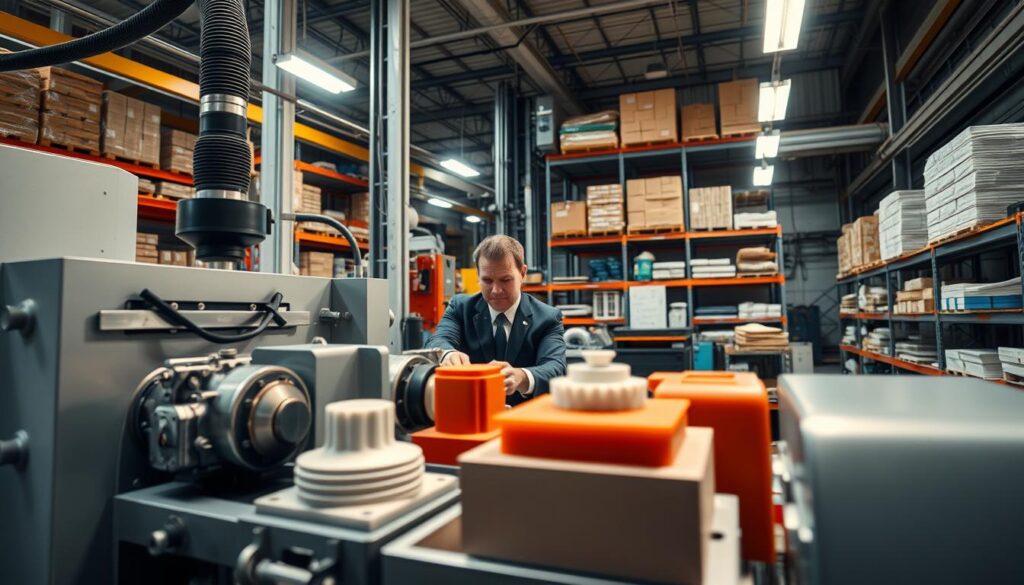
Ever curious about how complex plastic and composite parts are made with such precision? The secret is in a manufacturing process called compression molding.
This method uses heat and high pressure to shape materials like thermosetting polymers or thermoplastic compounds. It helps manufacturers create high-quality parts for many industries.
Key Takeaways
- A manufacturing process that creates plastic and composite parts.
- Involves heat and high pressure to shape materials.
- Used for producing parts with complex geometries.
- Applicable to various industries, including automotive and aerospace.
- Enhances product durability and quality.
What Is Compression Molding?
Compression molding is a way to shape plastics, rubbers, and composites into exact forms. It involves putting the material in a heated mold and pressing it until it matches the mold’s shape.
Definition and Basic Explanation
Compression molding turns raw materials into specific shapes using heat and pressure. First, a material, often preheated, is placed in a mold. Then, the mold closes, and pressure is applied, making the material fill the mold.
Experts say this method is great for making high-quality parts with complex shapes from materials like thermosets and rubber. It’s because it allows for parts with exact sizes and smooth surfaces.
How the Process Works and Typical Applications
The compression molding process is used for many materials, including thermosets, composites, and rubber. Thermosets, like phenolics and epoxy, are molded this way because they can be shaped into complex forms and then set.
- Thermosets are used in places needing high heat resistance and chemical resistance.
- Composites are used for their strength, durability, and resistance to wear and tear.
- Rubber and elastomeric materials are molded for their flexibility and resistance to wear.
Compression molding is used to make car parts, industrial items, and everyday goods. It’s praised for making big, complex parts with precision and little waste.
Three Types of Compression Molds
Knowing the different types of compression molds is key for making high-quality products and saving money. These molds are mainly divided into three types: Open Flash Mold, Semi-Positive Mold, and Positive Mold. Each has its own design and function.
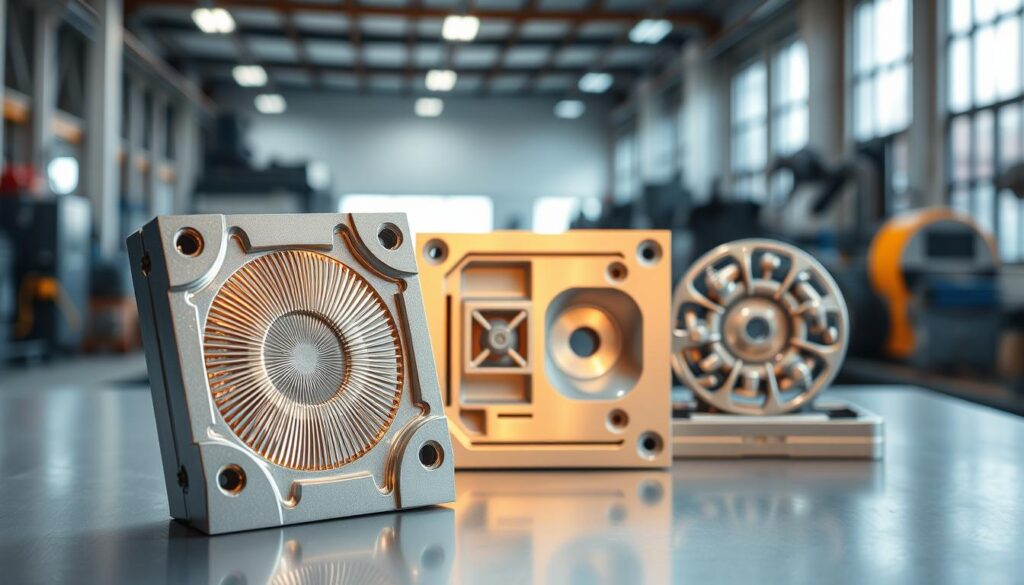
Open Flash Mold
The Open Flash Mold is the simplest of the three. It lets extra material, called flash, form and then get cut off. This mold is great because it’s easy to use and doesn’t cost much. It’s perfect for when flash isn’t a big deal.
Semi-Positive Mold
The Semi-Positive Mold offers a middle ground. It controls part shape and flash better than the open flash mold but is simpler than the positive mold. It’s used when you need more control but don’t want the complexity of a positive mold.
Positive Mold
The Positive Mold has a precise mold cavity for better part detail and less flash. It’s best for high-precision needs and when material control is key. This mold makes products with fewer defects and less need for post-molding work.
In short, picking the right compression mold depends on the product’s needs. This includes material, precision, and how much you plan to make. Choosing the right mold helps make the molding process more efficient and improves product quality.
Common Compression Molding Machines
Compression molding uses special machines to apply pressure and heat. These machines are made to give the right amount of force and control the temperature. This helps make high-quality molded parts.
Hydraulic Presses and Heated Platen Machines
Hydraulic presses are often used in compression molding. They use hydraulic fluid to apply the needed pressure. Heated platen machines add heat to the mold and material.
Together, hydraulic presses and heated platen machines control the molding process well. This makes it possible to create complex parts accurately.
Automatic vs Semi-Automatic vs Manual Compression Molding Setups
Compression molding machines vary in automation levels. Automatic machines need little human help, using controls and robots. Semi-automatic machines require some manual steps, like loading the mold. Manual machines are fully operated by people.
The choice of machine depends on the project, how much is made, and quality needs.
| Machine Type | Level of Automation | Typical Application |
|---|---|---|
| Automatic | High | High-volume production |
| Semi-Automatic | Medium | Medium-volume production |
| Manual | Low | Low-volume production or prototyping |
The Compression Molding Process
Compression molding is a detailed process. It needs careful material preparation and precise molding techniques. This is key for making high-quality parts with consistent properties.
Material Preparation and Placement
The first step is preparing the material, called the “charge.” It’s preheated to a certain temperature to make it easier to mold. Then, the preheated material is placed into the mold cavity with care.

Mold Closure, Pressure, and Curing
Next, the mold is closed, and pressure is applied. The mold is then heated to help the material cure. This mix of pressure and heat makes the material flow and take the desired shape.
The curing process is very important. It decides the final properties of the part. How long it cures depends on the material and the part’s thickness.
Part Cooling and Removal
After curing, the mold is cooled. This lets the part be safely removed without deforming. The part is then ejected from the mold, and any extra material is trimmed off.
The entire compression molding process can be summarized in the following table:
| Process Step | Description | Key Factors |
|---|---|---|
| Material Preparation | Preheating the material to enhance moldability | Temperature, material properties |
| Mold Closure and Pressure | Closing the mold and applying pressure | Pressure level, mold design |
| Curing | Heating the material to facilitate curing | Temperature, curing time |
| Part Cooling and Removal | Cooling the mold and ejecting the part | Cooling rate, part design |
Compression Molding Defects
It’s key for makers to know about common defects in compression molding. This knowledge helps in making top-notch parts every time. Even with new tech, problems can pop up, messing with the quality and use of molded parts.
Flash and Excess Material Issues
Flash is a big problem in compression molding. It happens when too much material gets out of the mold. This means more steps to clean up, which adds time and money. Fixing the mold design and using the right amount of material can solve this.
Blisters, Chips, Shrinkage, and Flow Lines
Blisters and chips come from uneven material flow or bad curing. Shrinkage makes parts smaller as they cool, causing size issues. Flow lines show up on parts when material doesn’t move right during molding. Changing mold temperature, preheating material, and adjusting pressure can help fix these problems.
Short Shots and Incomplete Fills
Short shots happen when material doesn’t fill the mold fully. This is often because of too little material or wrong molding settings. Using the right amount of material and tweaking molding conditions can stop this. Incomplete fills get better with a better mold design and good venting for full filling.
Knowing why these defects happen and how to avoid them helps makers make better parts. This leads to higher quality and more consistent results in compression molding.
Compression Molding Design Guide
Creating effective compression molding designs is key for precise and efficient production. The part’s design greatly affects its manufacturability and quality.
Wall Thickness Recommendations and Avoiding Undercuts
Ensuring uniform wall thickness is vital in compression molding design. Uniform wall thickness ensures even material flow and curing. This reduces defects like warping or sink marks. Aim for a wall thickness of 2 mm to 5 mm for most parts.
It’s also important to avoid undercuts. Undercuts can make the molding process harder and part removal tricky. Designers should aim for parts with minimal or no undercuts to simplify tooling and cut costs.

Insert Molding and Parting Line Considerations
Insert molding involves adding inserts to the mold before material. It’s used for complex parts with integrated components. Designers must ensure the insert is secure and material flows evenly around it.
The parting line is also key in compression molding design. It’s where the mold halves meet. A well-designed parting line helps avoid flash and ensures proper part formation. Designers should pick the parting line location carefully to avoid visible seams or too much flash.
Design for Manufacturability and Uniform Material Flow
Designing for manufacturability means thinking about production during design. It ensures the part can be molded easily, material flows well, and the part ejects without damage. Uniform material flow is essential for consistent quality and fewer defects.
To get uniform material flow, designers should focus on mold design, gate location, and material properties. Optimizing these can lead to efficient production of high-quality parts.
Types of Materials Used in Compression Molding
Compression molding works well with many materials. This makes it a flexible method for creating parts.
It can handle thermosetting plastics and composites like SMC/BMC, phenolics, and epoxy. These are picked for their strength and ability to resist heat and chemicals.
Thermosetting Plastics and Composites
Phenolics and epoxies are often used because they can handle high temperatures. They keep their shape even when stressed. SMC and BMC composites are also favored for their strength and design flexibility.
Rubber and Elastomeric Materials
Rubber and elastomeric materials are also molded through compression molding. They are known for being elastic, resistant to wear, and good at absorbing vibrations.
These materials are used to make seals, gaskets, and other parts that need to be flexible and last long.
Knowing what each material can do helps manufacturers choose the right one. This way, they can make parts that are both high-quality and meet their needs.
Applications of Compression Molding
Compression molding is used in many areas, like cars, industrial parts, and everyday items. It’s great for making high-quality, detailed parts with precision and consistency.
This method is popular in many fields, including cars, planes, and consumer goods. It’s chosen for making parts that last long and can handle different environments well.
Automotive Components
The car industry uses a lot of compression-molded parts. Things like panels, fenders, spoilers, and other exterior and interior parts are made this way. It’s perfect for creating big, complex parts with a smooth finish.
Experts say, “Compression molding makes lightweight, strong parts. These parts help cars use less fuel and pollute less.” Using materials like SMC and BMC makes these parts even better.

Industrial and Consumer Parts
Compression molding is also used for industrial and consumer parts. It’s great for making parts for electrical devices, machinery, and more. Durability and precision are key here.
This method works well with thermosetting plastics and composites. These materials resist heat and chemicals well. So, compression-molded parts are used in many areas, from industrial machinery to consumer electronics.
A recent report says, “The need for compression-molded parts is rising. This is because of better materials and more use in new fields.” This shows how important compression molding is in today’s making things.
Advantages and Disadvantages of Compression Molding
Compression molding is a standout in manufacturing. It’s known for its unique mix of benefits and challenges. This method is popular in many industries for its efficiency and quality.
One big plus is its low tooling cost. This makes it appealing to those wanting to save on initial costs. It also produces minimal waste, thanks to precise material use in the mold.
Key Advantages
- Suitable for large parts: It’s perfect for making big items like car panels and industrial parts.
- High-quality surface finish: It offers a top-notch finish, often avoiding the need for extra work.
- Material versatility: It works well with many materials, including thermosets, composites, and rubber.

Key Disadvantages
But, compression molding also has downsides. A big one is its longer cycle times compared to methods like injection molding.
- Limited geometry complexity: It’s not great for parts with complex shapes.
- Material flow limitations: It can be tricky to manage material flow, which might cause defects if not done right.
Trade-offs Compared to Other Molding Methods
When comparing it to other methods, like injection molding, some trade-offs are clear. Compression molding is cheaper for tooling and better for big parts. But, it might take longer and has limits on part complexity.
Knowing these trade-offs helps manufacturers pick the best molding method for their needs. By considering the pros and cons, they can improve their production and meet quality and efficiency goals.
Comparison with Other Molding Techniques
It’s important to know how compression molding compares to other methods. This helps in picking the right process for certain parts. Compression molding is often compared to injection molding and transfer molding. These are used for similar parts.
Key Differences in Molding Processes
Compression molding and injection molding have different costs and part complexities. Injection molding is best for making lots of complex parts with tight tolerances. On the other hand, compression molding is good for large, simple parts with lower tooling costs.
Comparison with Transfer Molding
Transfer molding is great for parts with complex shapes. It offers better part detail and material flow. But, it’s pricier than compression molding because of the transfer pot and runner system. The choice between these molding methods depends on the part’s material, shape, and how many will be made.
FAQs
What is compression molding?
What types of materials are used in compression molding?
What are the different types of compression molds?
Each of the three primary types—Open Flash Mold, Semi-Positive Mold, and Positive Mold—has a unique method of controlling part shape and flash.
What machines are used for compression molding?
Heated platen machines and hydraulic presses are widely used and can be set up manually, semi-automatically, or automatically.
What are the common defects in compression molding?
Flash, blisters, chips, and shrinkage are among the defects; flow lines, short shots, and incomplete fills also occur; these are frequently brought on by uneven flow, incorrect charge, or cooling problems.
How can defects in compression molding be prevented?
What are the advantages of compression molding?
What are the disadvantages of compression molding?
How does compression molding compare to injection molding?
What are the applications of compression molding?
What design considerations are important for compression molding?
Wall thickness and preventing undercuts are crucial factors, as are insert molding and parting line design, manufacturing viability, and even material flow.