
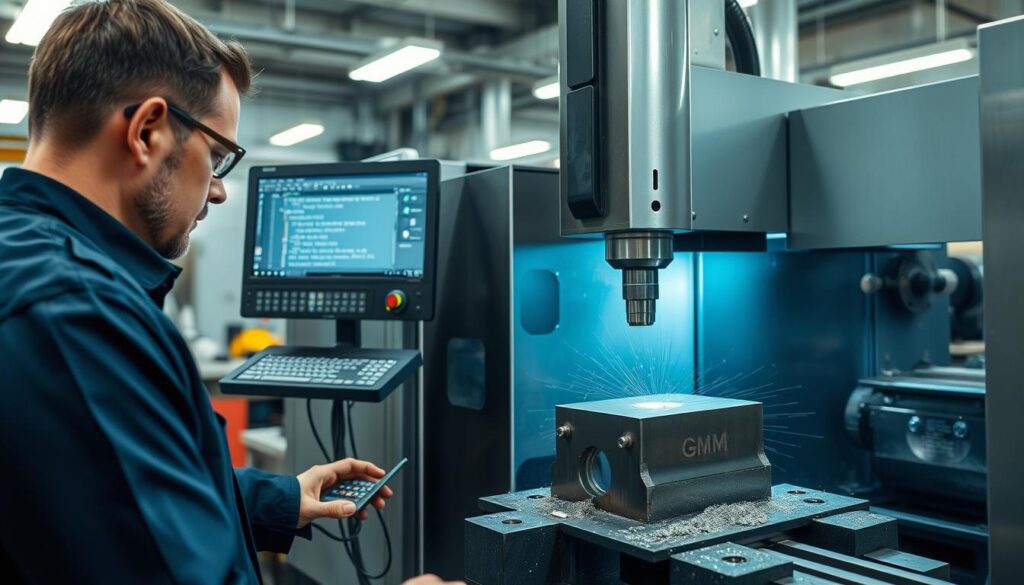
What’s the backbone of modern manufacturing that enables the creation of complex and sophisticated products? The answer is CNC machining. It uses computerized controls and machine tools to make precise parts from different materials.
CNC machining is a key process in manufacturing. Its importance is huge. At its core are CNC programming languages, like G and M codes. These codes are vital for controlling CNC machines.
Key Takeaways
- CNC machining is a core process in modern manufacturing.
- G and M codes are essential CNC programming languages.
- These codes control CNC machines to produce precise parts.
- CNC machining enables the creation of complex and sophisticated products.
- Computerized controls and machine tools are used in CNC machining.
What's CNC Machining?
CNC machining is a key part of today’s manufacturing world. It uses computer-controlled machines to make parts and products. This method has changed how goods are made, allowing for complex designs with great precision.
Definition and Overview of CNC Machining
CNC machining, or Computer Numerical Control machining, uses computers to control machine tools. It makes complex parts with high precision and accuracy. This is why it’s so important in industries like aerospace, automotive, and healthcare.
The process starts with a digital design from CAD software. This design is turned into G and M codes. These codes guide the CNC machine to make the part.
How CNC Machines Are Used in Manufacturing
CNC machines are very versatile. They can do tasks like milling, turning, grinding, and drilling. They work with materials like metals, plastics, and woods, making them very useful.
These machines are great for industries that need high precision. They help make products faster and cheaper, while also improving their quality.
Role of CAD and CAM in CNC Workflows
CAD and CAM software are very important in CNC machining. CAD is for designing parts or products. CAM creates the G and M codes for the CNC machine to follow.
Using CAD and CAM together makes the manufacturing process smoother. It helps achieve high precision and efficiency in CNC machining.
| Software | Function | Importance in CNC Machining |
|---|---|---|
| CAD | Designs parts and products | Essential for creating digital models |
| CAM | Generates G and M codes | Critical for instructing CNC machines |
How Does CNC Programming Control CNC Machines?
CNC programming uses G and M codes to control CNC machines. This control is key in modern manufacturing. It helps make complex parts with great accuracy.
Explanation of CNC Programming
CNC programming creates instructions for the CNC machine. These instructions are in a language the machine understands, mainly G and M codes. First, the part is designed with CAD software. Then, CAM software turns it into a CNC program.

How Codes Instruct Machine Movement and Actions
G codes control the CNC machine’s movement. They tell the machine the path and speed to follow. M codes handle extra tasks like turning on the spindle or changing tools. Together, they give the CNC machine all the instructions it needs.
The Relationship Between Design Data and Machine Execution
Design data from CAD software is turned into a CNC program. This process changes the design into G and M codes. These codes tell the machine how to make the part. CNC machining’s precision comes from following these instructions closely.
In summary, CNC programming is vital for CNC machines. It gives them detailed instructions through G and M codes. Knowing how these codes work is key to improving CNC machining.
What Are G-Codes in CNC Programming?
Understanding G-codes is key for good CNC programming. They control how CNC machines move and where they go. This makes it possible to make precise parts.
Definition of G-codes
G-codes, or geometry and motion commands, manage CNC machine movement. They are vital in CNC programming. They tell the machine how to move and where to place the tool. As Tom Li, a CNC programming expert, says, “G-codes are the heart of CNC programming, giving the exact instructions for precise machining.”
How G-codes Control Movement and Positioning
G-codes guide CNC machines by setting out the paths and coordinates for the tool. They use linear and circular commands for complex paths. For example, G01 tells the machine to move straight to a certain point.
Examples of Motion and Coordinate G-codes
Here are some common G-codes for motion and coordinate control:
- G00: Rapid positioning, for quick moves to a point.
- G01: Linear interpolation, for straight-line moves to a point.
- G02/G03: Circular interpolation, for circular path moves.
These G-codes are critical for controlling CNC machines. They help make complex parts with great precision.
“The precision and accuracy of CNC machining rely heavily on the correct use of G-codes.” –
CNC Machining Expert
What Are M-Codes in CNC Programming?
M-codes in CNC programming let you control machine functions with precision. They are key for managing the extra actions of CNC machines.
Miscellaneous Functions
M-codes are instructions for actions like spindle rotation, tool changes, and coolant flow. They are vital for CNC machines to work well.
M-code Functions cover a wide range. For example, they can change the spindle’s direction and speed, handle tool changes, and control coolant flow. This ensures machining processes are effective.
Controlling Auxiliary Machine Actions
M-codes are essential for controlling extra actions needed for CNC programs. These actions include starting and stopping the spindle, changing tools, and managing coolant flow.
For instance, M03 starts the spindle in a clockwise direction. M05 stops it. M08 turns on the coolant, and M09 turns it off.
Typical M-Code Functions
Some common M-code functions include:
- Spindle control (e.g., M03, M04, M05)
- Tool changes (e.g., M06)
- Coolant control (e.g., M08, M09)
- Program control (e.g., M00, M01, M02, M30)
| M-Code | Function |
|---|---|
| M03 | Spindle clockwise |
| M04 | Spindle counterclockwise |
| M05 | Spindle stop |
| M08 | Coolant on |
| M09 | Coolant off |

CNC programming experts say, “Understanding M-codes is key to writing efficient CNC programs.” Using M-codes well boosts CNC machining’s productivity and accuracy.
“M-codes are the backbone of CNC programming, enabling precise control over machine functions and auxiliary actions.”
A List of G and M Codes for CNC Machining
CNC machining needs a good grasp of G and M codes. These codes control CNC machines’ movements and functions. They make sure the work is precise and done efficiently.
Common G-Codes
G-codes manage CNC machines’ motion. Here are some key G-codes:
- G00: Rapid positioning
- G01: Linear interpolation
- G02/G03: Circular interpolation (clockwise and counterclockwise)
- G17/G18/G19: Plane selection (XY, XZ, YZ planes)
- G20/G21: Unit selection (inches or millimeters)
Common M-Codes
M-codes handle various machine functions. Here are some common M-codes:
- M00: Program stop
- M01: Optional stop
- M02: End of program
- M03/M04: Spindle on (clockwise and counterclockwise)
- M05: Spindle stop
- M06: Tool change
- M08/M09: Coolant on/off
Notes on Machine-Specific Variations
While many CNC machines use the same G and M codes, there are exceptions. Different machines and makers might have their own codes. Always check your CNC machine’s manual for the right info.
Knowing these differences helps make CNC programs work best for your machine. It ensures they run smoothly and efficiently.
Let's Summarize The Difference Between G and M Codes
Knowing the difference between G and M codes is key for good CNC programming. In CNC machining, both codes are important but for different reasons and uses.
Key differences in purpose
G-codes control the movement of CNC machines. They tell the machine where to move and how to move. M-codes, on the other hand, handle extra functions like spindle rotation and tool changes.
G-codes are mainly for the main machining tasks. They define the part’s shape and movement. M-codes are for extra functions needed during machining.
How they work together in CNC programs
In CNC programs, G and M codes work together. G-codes move the tool, while M-codes control the spindle or tool changes. This mix allows for detailed and precise machining.
This teamwork makes complex parts possible. It combines the control of movement and machine functions for better results.

Why both are essential
G and M codes are both vital for CNC programming. G-codes are needed for the machine’s movement. M-codes handle the extra functions like tool changes.
Without G-codes, the machine can’t move to create parts. Without M-codes, it can’t perform tasks like tool changes or coolant use.
The table below shows the main differences and roles of G and M codes:
| Code Type | Primary Function | Examples |
|---|---|---|
| G-codes | Motion control | G00, G01, G02/G03 |
| M-codes | Auxiliary machine functions | M00, M01, M02 |
In conclusion, knowing how to use G and M codes is essential for CNC machining. Understanding their differences and how they work together helps programmers create better CNC programs.
Celerity Precision's Expertise in CNC Machining
Celerity Precision is a leader in CNC machining services. They offer a wide range of services for different industries.
Overview of Services
Celerity Precision provides CNC machining services like milling, turning, and grinding. Their modern facilities use the latest technology for complex projects.
Their team knows how to program and run CNC machines. They make sure every part is made to exact standards. They also use G and M codes, key for CNC programming.
Specializations in Machining, Programming, and Quality Control
Celerity Precision is great at making complex parts with high precision. They use G and M codes to make each project more efficient and accurate.
Quality control is a big part of their service. They check every part carefully to make sure it meets standards.
Improving Precision and Efficiency with G and M Codes
Using G and M codes well is key in CNC machining. Celerity Precision knows these codes inside out. This helps them make products faster and better.
| Code Type | Function | Benefits |
|---|---|---|
| G-Codes | Control movement and positioning | Enhances precision and accuracy |
| M-Codes | Manage auxiliary machine functions | Improves efficiency and reduces downtime |
Thanks to their G and M code expertise, Celerity Precision can make top-quality parts. These parts meet even the toughest standards.
Conclusion
Learning G and M codes is key for top-notch CNC programming and precision making. These codes help machinists talk clearly to CNC machines. This ensures that complex designs are done right.
G codes handle the machine’s shape and movement. M codes take care of extra tasks. Together, they give precise control over making things. This means parts can be made with great detail and accuracy.
Celerity Precision shows how vital knowing G and M codes is. By using these codes well, makers can make their work better. They can work faster and get better results in CNC programming.