
PMMA (Acrylic) CNC Machining
What makes a material perfect for precise engineering and looks in fields like medical devices and display fixtures?
The answer is its special mix of traits, like being clear and easy to machine. PMMA (Acrylic) is a flexible plastic that’s top for CNC machining because of its great qualities.
It can be shaped exactly and keep a high-quality finish. This makes it great for many uses. As industries need materials that look good and work well, knowing about Acrylic CNC Machining is key.
Key Takeaways
- Understanding the properties of PMMA and its suitability for CNC machining.
- The importance of precision engineering in various industries.
- How Acrylic CNC Machining meets both functional and aesthetic demands.
- Applications of PMMA in different sectors.
- Benefits of using Acrylic for CNC machining projects.
Introduction to PMMA (Acrylic) CNC Machining
PMMA, or acrylic, is a versatile material used in CNC machining. It’s known for its excellent machinability and optical clarity. This makes it a top choice for creating custom parts and prototypes that need precision and look great.
CNC machining of acrylic uses computer-controlled machines to cut and shape the material. This method allows for the creation of complex parts with high accuracy. It’s a favorite in many industries.
Using CNC machining for acrylic has many benefits. It produces parts with high precision and smooth finishes. It also makes complex geometries possible, which is hard or impossible with traditional methods.
Acrylic CNC-machined parts are used in many areas. These include optical and display components, automotive parts, and architectural features. The combination of acrylic’s versatility and CNC machining’s precision makes it perfect for many industries.
| Industry | Common Applications |
|---|---|
| Optical and Display | Lenses, Displays, Lighting Fixtures |
| Automotive | Dashboard Components, Trim Parts, Lighting Housings |
| Architectural | Signage, Decorative Features, Lighting Elements |
What is PMMA (Acrylic)?
PMMA stands for Polymethyl Methacrylate, a clear and strong material. It’s also known as acrylic or Plexiglas. It’s a clear plastic that many industries use because of its special qualities.
Material Overview and Properties
PMMA is very clear, making it a great choice instead of glass. It’s also tough and won’t break easily. Plus, it’s light and can handle the weather well, perfect for outside use.
Key properties of PMMA include:
- High optical clarity
- Impact resistance
- Lightweight
- Good weather resistance
- Easy to fabricate and machine
Optical, Mechanical and Thermal Characteristics
PMMA is very clear, almost like glass. It’s not as scratch-resistant as glass but can take a hit better. It gets soft and bends when it gets too hot.
Some of the key optical, mechanical, and thermal characteristics of PMMA are:
| Characteristic | Description | Value/Range |
|---|---|---|
| Refractive Index | A measure of how much it bends light | 1.49 |
| Impact Resistance | Ability to withstand impact without shattering | High |
| Glass Transition Temperature | Temperature at which it softens | around 100°C to 120°C |
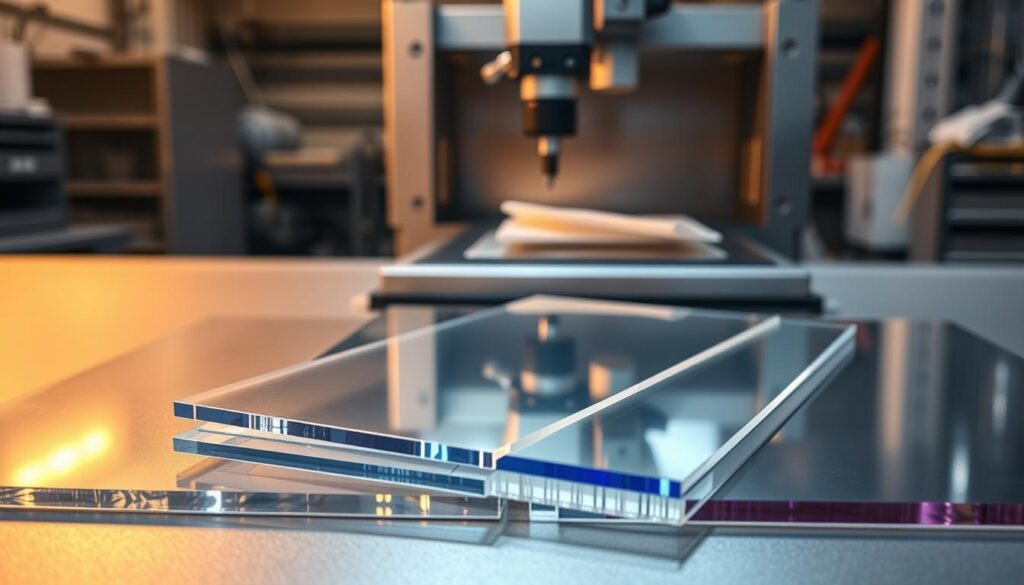
Knowing these traits helps pick PMMA for things like displays or car parts.
PMMA CNC Machining Process
Manufacturers use advanced CNC machining processes to make precise acrylic parts. These processes involve several key techniques for high-quality PMMA parts.
CNC Milling of PMMA
CNC milling is key in shaping PMMA. Choosing the right tools and settings is important to avoid melting. For example, milling PMMA on Evo CNC needs a good understanding of the material.
Using high-quality milling tools and keeping the spindle speed right is important. This helps get smooth finishes and prevents damage.
CNC Drilling & Cutting Techniques
CNC drilling and cutting are vital for precise holes and cuts in PMMA. Peck drilling helps avoid cracking and improves accuracy.
When cutting PMMA, the right cutting tools and a steady feed rate are key. This ensures clean cuts and less waste.
CNC Turning for Acrylic Parts
CNC turning makes cylindrical PMMA parts with high precision. This process needs special tools and a good understanding of the material.
To get the best results, controlling the spindle speed and feed rate is important.
CAM Programming & G-Code Setup
CAM programming is essential in CNC machining. It creates G-Code that tells the CNC machine how to make the PMMA part.
Good CAM programming needs a deep understanding of machining and material properties. This ensures efficient and accurate machining.
Tooling and Cutting Parameters
Tooling and cutting parameters are key to making high-quality CNC-machined PMMA parts. The right tools and settings make the machining process better. They help avoid defects and make the work more efficient.
Tool Selection
Picking the right tool is very important in PMMA CNC machining. The tool’s number of flutes, material, and shape affect the surface quality. For example, a 1 or 2 flute bit can make the process gentler on the machine.
Tool Material: Carbide tools are best because they are hard and wear-resistant. HSS tools are good for less tough jobs.
Spindle Speed & Feed Rate Guidelines
Getting the spindle speed and feed rate right is key for a good finish and to avoid damaging the PMMA. It’s important to find a balance for efficient and precise machining.
| Operation | Spindle Speed (RPM) | Feed Rate (mm/min) |
|---|---|---|
| Roughing | 10,000 – 15,000 | 500 – 1000 |
| Finishing | 15,000 – 20,000 | 200 – 500 |
Coolant and Heat Control Strategies
Keeping the temperature stable during machining is important to avoid melting or warping of PMMA. Good coolant strategies help keep the temperature steady, protecting the workpiece.
Compressed air or dedicated cooling systems can help cool down the machine. Also, using a low depth of cut and/or stepover can reduce heat during machining.

Workholding & Fixture Considerations
In PMMA CNC machining, workholding and fixture considerations are key. It’s vital to hold PMMA parts securely to avoid damage and ensure accuracy.
Choosing the right workholding strategy is important for PMMA. This material is brittle and can chip or crack easily. The right amount of clamping force is needed to prevent movement or cracking.
There are several workholding methods to use, depending on the part’s shape and the machining task. Vacuum clamping, double-sided tape, and custom fixtures are common. They help hold PMMA securely without causing stress.
Workholding Methods for PMMA CNC Machining
| Method | Description | Advantages |
|---|---|---|
| Vacuum Clamping | Uses vacuum pressure to hold the PMMA part in place. | Even pressure distribution, minimizes risk of damage. |
| Double-Sided Tape | Applies tape to the back of the PMMA part to secure it to the machining table. | Easy to apply, suitable for thin parts. |
| Custom Fixtures | Specifically designed fixtures to hold complex geometries. | High precision, can be tailored to specific part geometries. |
Fixture considerations are also critical for PMMA CNC machining success. Fixtures must support the part well to keep it stable during machining. The material and design of the fixture should match the machining forces and PMMA’s properties.
With proper workholding and fixture planning, manufacturers can greatly enhance the quality and accuracy of their PMMA CNC machining.
Surface Finishing Options
Getting a high-quality surface finish is key for PMMA CNC machined parts. It affects how they look and work. The finish can make the part clearer, stronger, and better at its job.
There are many ways to improve PMMA parts’ look and function. These methods depend on what you need. You might want a better look, clearer optics, or more durability.
Flame Polishing
Flame polishing is a common way to smooth out PMMA parts. It uses a controlled flame to melt the surface. This removes blemishes, leaving a smooth finish.
Flame polishing works well for complex shapes. It can get into tight spots that mechanical methods can’t.

Mechanical Polishing & Buffing
Mechanical polishing and buffing are old-school ways to get a shiny finish. They use finer abrasives and compounds to remove marks. Mechanical polishing is great for precise finishes.
It can make surfaces range from matte to very shiny.
Chemical & Vapor Polishing
Chemical and vapor polishing are advanced methods for top-notch finishes. Chemical polishing uses chemicals to remove the top layer. Vapor polishing uses solvent vapor to smooth out the surface.
Both methods can make surfaces very smooth. They’re good for delicate or detailed parts because they don’t need to touch the surface.
Each technique has its own benefits and is best for certain needs. Choosing the right one ensures PMMA CNC machined parts look and work as they should.
Design and Machining Best Practices
To get the best results in PMMA CNC machining, following best practices in design and machining is key. This helps avoid common problems like chipping and cracking. It also ensures parts have high optical clarity and smooth edges.
Minimizing Chipping and Cracking
Chipping and cracking are big worries when working with PMMA. To lessen these problems, designers and machinists should take a few steps:
- Optimize part design to reduce stress concentrations that can lead to cracking.
- Use appropriate tooling, such as sharp, high-quality end mills and drills, to minimize the risk of chipping.
- Implement controlled machining parameters, including feed rates and spindle speeds, to avoid excessive stress on the material.
Tool selection is very important in avoiding chipping. Using tools with the right geometry and keeping them sharp can greatly reduce chipping.
Achieving Optical Clarity and Smooth Edges
To get parts with optical clarity and smooth edges, focus on both design and machining. Key points to consider are:
- Design parts with smooth transitions and avoid complex shapes that are hard to machine.
- Use precise machining and high-quality tools for smooth edges.
- Apply post-machining processes, like polishing, to boost optical clarity.
Polishing techniques, like flame polishing or mechanical polishing, can greatly improve PMMA part clarity. The right polishing method depends on the part’s needs and the desired finish.
Tolerances and Accuracy in PMMA CNC Machining
The accuracy of CNC-machined PMMA parts depends on understanding and controlling tolerances. Tolerances are the acceptable limits of variation in a part’s dimensions. In PMMA CNC machining, precise tolerances are key to ensure the final product meets specifications.
Maintaining accuracy in PMMA CNC machining involves several factors. These include the CNC machine’s quality, the tooling used, and machining parameters. Tool wear and material deformation can affect accuracy. So, it’s important to monitor tool condition and adjust machining parameters as needed.

To achieve high accuracy in PMMA CNC machining, understanding tolerances for different machining processes is essential. The table below shows typical tolerances for various CNC machining operations.
| Machining Operation | Typical Tolerance |
|---|---|
| CNC Milling | ±0.01 mm |
| CNC Drilling | ±0.05 mm |
| CNC Turning | ±0.005 mm |
By understanding these tolerances and choosing the right machining process, manufacturers can achieve the desired accuracy in their PMMA parts. Quality control measures, like regular inspection and calibration of CNC machines, can also improve accuracy.
In conclusion, achieving high accuracy in PMMA CNC machining requires a deep understanding of tolerances and the factors that influence them. By controlling these factors and selecting the right machining processes, manufacturers can produce high-quality PMMA parts that meet precise specifications.
Common Challenges & Solutions
PMMA CNC machining faces challenges like heat issues and dimensional problems. These can affect the quality and precision of parts.
Heat-Related Issues (Melting / Warping)
PMMA’s low melting point makes it prone to heat damage during CNC machining. Too much heat can melt or warp the material, harming the part’s integrity.
To tackle heat problems, several methods can be used:
- Using sharp cutting tools to reduce friction and heat generation
- Implementing coolant systems to dissipate heat
- Optimizing spindle speeds and feed rates to minimize heat buildup
Coolant and Tool Sharpness are key to avoiding heat damage. A machining expert says, “Keeping tools sharp and using coolants can greatly lower heat damage risks in PMMA CNC machining.”

Dimensional Instability and Stress Fractures
PMMA CNC machining also faces issues like dimensional instability and stress fractures. These problems can stem from bad workholding, too much tool pressure, or material stress.
| Cause | Effect | Solution |
|---|---|---|
| Improper Workholding | Dimensional Instability | Optimize Fixture Design |
| Excessive Tool Pressure | Stress Fractures | Adjust Tool Parameters |
| Material Stress | Warping or Cracking | Anneal Material Before Machining |
Knowing the causes of dimensional instability and stress fractures helps machinists prevent these problems. This ensures the production of high-quality PMMA parts.
“The key to successful PMMA CNC machining lies in understanding the material’s properties and adapting machining strategies.”
Applications of CNC-Machined Acrylic Parts
Acrylic is known for its clear look and ability to resist UV light. It’s often used in CNC machining for many different needs. Its strength and flexibility make it great for many uses, from display items to complex parts for machines.

Optical & Display Components
Acrylic is perfect for parts that need to be clear and let light through. CNC machining lets us make lenses, light guides, and covers for displays. These are used in fields like electronics and communication.
Key applications include:
- Display screens and protective covers for electronic devices
- Lenses for lighting fixtures and optical instruments
- Light guides for backlighting in LCD displays
Automotive and Lighting Parts
In cars, CNC-machined acrylic parts are used for lights, dashboard covers, and trim. Its precision machining lets us create complex shapes and designs. This meets the high standards of the car industry.
Notable applications in this field include:
- Tail light covers and indicator lenses
- Dashboard display covers and bezels
- Interior trim components with complex geometries
Architectural and Signage Applications
Acrylic is also great for building features and signs because it’s strong and looks good. CNC machining can make detailed designs and shapes. These are used in building facades, signs, and decorations.
Common uses in architectural and signage applications include:
- Illuminated signage and lettering
- Architectural features such as room dividers and decorative panels
- Exhibition displays and booth components
Advantages and Limitations of PMMA CNC Machining
Knowing the advantages and limitations of PMMA CNC machining is key. PMMA, or acrylic, is popular in CNC machining. It’s versatile and can produce high-quality finishes.
One big advantage is its ability to make parts clear and smooth. This is great for optical and display components where looks matter. Plus, PMMA is easy to machine, allowing for detailed and precise parts.
Another big advantage is PMMA’s toughness and resistance to the environment. It’s weather-resistant and can handle different temperatures. This makes it good for outdoor applications, like building features and signs.
But, PMMA CNC machining has some limitations. It can chip or crack during machining. Using the right tools and techniques can help, but it needs careful setup.
Also, PMMA can melt or warp if not machined correctly. It’s important to control spindle speed and feed rates to avoid damage.
In summary, PMMA CNC machining has many advantages, like clarity and durability. But, it also has limitations, like chipping and heat issues. Understanding these helps manufacturers get the best results.
Choosing a PMMA CNC Machining Service Provider
Choosing the right PMMA CNC Machining service is key for top-notch parts. A good service provider should know a lot about CNC Machining. They also need to understand PMMA (acrylic) well.
Look for a service that uses the latest CNC Machining tech. They should have a history of making complex acrylic parts. Also, they should offer different surface finishes to fit your needs.
Partner with a trusted PMMA CNC Machining service to start making parts today. Get a quick quote from a reliable maker to bring your designs to life.
FAQ
What is PMMA (Acrylic) CNC Machining?
PMMA (Acrylic) CNC Machining uses computer-controlled machines. These machines cut and shape acrylic materials into custom parts and prototypes.
What are the benefits of using PMMA (Acrylic) for CNC Machining?
PMMA is great for CNC Machining because it’s clear, easy to work with, and versatile. It’s perfect for projects that need precision and look good.
What are the different surface finishing options available for PMMA parts?
You can finish PMMA parts in several ways. Options include flame polishing, mechanical polishing, and chemical or vapor polishing. Each method has its own benefits and uses.
How can I minimize chipping and cracking during PMMA CNC Machining?
To avoid chipping and cracking, follow best practices. Use the right tools and cutting settings. Also, make sure your work is properly held and fixed.
What are the common challenges encountered during PMMA CNC Machining?
Issues like melting or warping can happen. To solve these, use coolants and control heat. Also, choose the right tools and settings.
What are the applications of CNC-machined acrylic parts?
CNC-machined acrylic parts are used in many ways. They’re good for optical and display items, car and lighting parts, and even in buildings and signs. They’re precise, clear, and versatile.
How do I choose a reliable PMMA CNC Machining service provider?
Look for a service provider with experience in acrylic machining. Check their equipment and quality control. This ensures you get parts that meet your needs.
What are the advantages and limitations of PMMA CNC Machining?
PMMA CNC Machining is great for making complex parts with high precision. But, it can face issues like heat damage and size problems. These can be fixed with the right design and machining.
What are the tolerances and accuracy achievable with PMMA CNC Machining?
PMMA CNC Machining can be very precise. It can achieve tolerances from +/- 0.001 to +/- 0.01 inches, depending on the project and conditions.
What is the importance of tooling and cutting parameters in PMMA CNC Machining?
Tooling and cutting parameters are key in PMMA CNC Machining. They affect the quality and accuracy of the parts. Choosing and optimizing them is essential for the best results.